
Different Colors Vary Greatly in UV Light Penetration
UV light must penetrate the ink film to trigger curing. Pigments of different colors differ drastically in UV light absorption and scattering capacity:
- Black Ink (Hardest to cure)
Carbon black pigment absorbs nearly all UV wavelengths, blocking light penetration.
Solutions: Adopt formulations with high reactivity and low pigment loading; deploy photoinitiators specifically absorbing long-wave UVA (395 nm and above), as long-wave UV delivers stronger penetration. Meanwhile, strictly control ink film thickness to avoid incomplete curing at the substrate bottom caused by over-thick layers. - White Ink (Equally hard to cure)
Titanium dioxide pigments strongly reflect and scatter UV light, preventing light from reaching the ink-substrate interface.
Solutions: Use an ultra-high reactivity photoinitiator system to rapidly form a cured surface film that locks uncured ink underneath, followed by long-wave UV to complete deep-layer curing. The selection of titanium dioxide (particle size, surface treatment) exerts a critical impact on curing speed. - CMYK Inks (Relatively easy to cure)
Cyan, magenta and yellow pigments each have a unique light transmission window, meaning they are transparent to UV light at specific wavelengths. Optimized formulations match each color with a dedicated photoinitiator whose absorption peak aligns perfectly with the pigment’s transmission window for efficient curing. For instance, yellow pigment is transparent to blue-violet light, so photoinitiators absorbing this band can be used for high-efficiency curing. - Varnish / Clear Inks (Easiest to cure)
Free of pigment interference, UV light can reach the substrate directly, enabling the fastest and most thorough curing.
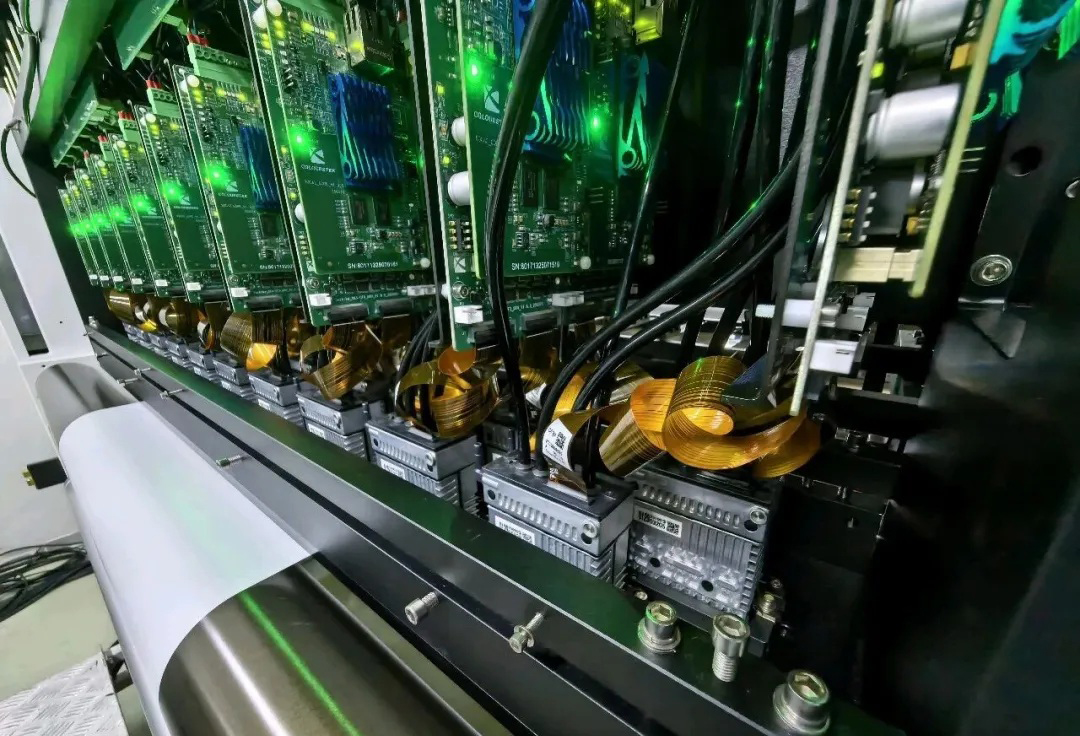
Micro-droplet & Thin Film Control: Resolve Curing Defects via Ink Volume Regulation
Excessively thick ink films block UV penetration entirely. This requires precise coordination between software and printhead control technology.
Core Principle: Layered Curing by Splitting Heavy Ink Deposits
Instead of jetting a large volume of ink onto the substrate in one pass, proprietary software algorithms split heavy ink coverage areas into multiple thin layers, which are printed by separate printhead channels. Each layer is immediately cured by UV light right after deposition.

Three Practical Implementation Methods
Method A: Multi-channel Printheads with Interlayer Curing Lamps
Separate printhead arrays dedicated to each single color. Taking white ink with high hiding power as an example: instead of one set of white printheads, three sets are deployed.
- The first set jets an ultra-thin white ink layer, instantly pre-cured by a trailing UV lamp;
- The second set deposits another thin layer, followed by secondary pre-curing;
- The third set completes the required whiteness with final full curing.
Each layer remains thin enough for unobstructed UV penetration.
Method B: Grayscale Variable Micro-droplet Technology
Leverage the variable droplet function of high-end printheads. For areas requiring heavy ink coverage, ultra-small picoliter droplets (2 pl or 3 pl) are ejected at high frequency to form thinner, more uniform wet films. Films formed by tiny droplets are thinner and contain less internal light scattering than those from large droplets, greatly facilitating UV penetration.
Method C: Precise Waveform & Screening Calculation
Professional RIP software performs color separation and halftone processing for images to eliminate solid heavy dot patches. Optimized screen structures evenly distribute ink film thickness across the print area, eliminating localized over-thick layers that lead to incomplete curing.
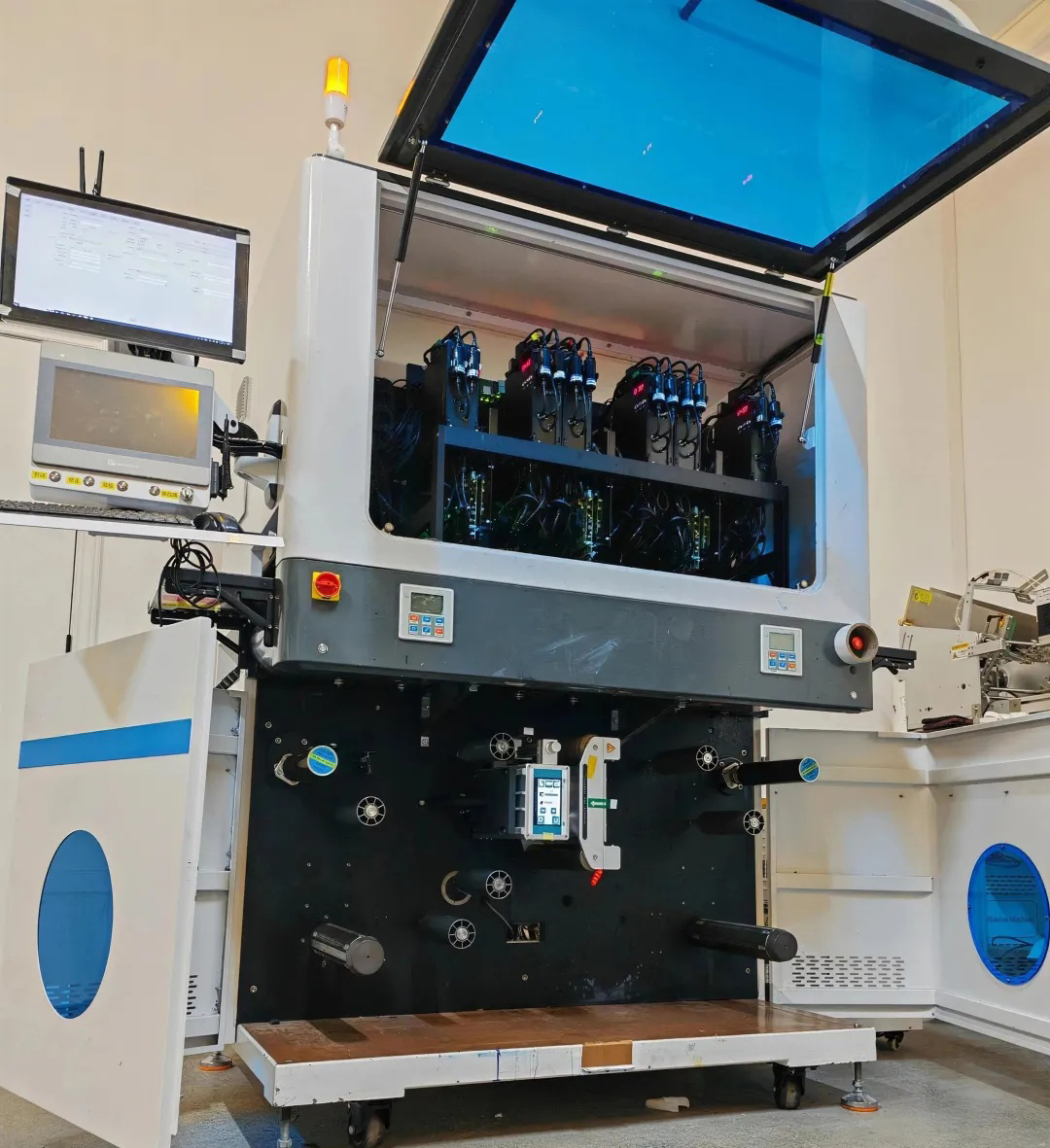
Supplementary Supporting Optimizations for Mass Production Lines
- Upgraded UV Light Source System for Multi-color Compatibility
- Hybrid-band LED UV lamps combining short-wave 365 nm and long-wave 395 nm output: short wavelengths boost curing efficiency for CMYK colors, while long wavelengths penetrate thick black and white ink layers.
- Water-cooled high-power LED UV delivers stable energy without substrate thermal deformation; close lamp-to-substrate distance maximizes energy delivery to the bottom of ink films.
- Nitrogen inert atmosphere chambers eliminate oxygen inhibition, especially critical for white and thick black inks to prevent surface tackiness.
- Optimized Ink Formulation Matching
- Low-shrinkage, high-flexibility acrylate resins reduce internal stress and cracking during thick-film curing.
- Composite anti-oxidation photoinitiators (amine co-initiators + phosphine oxide initiators) counteract free radical quenching by surface oxygen.
- Dispersant additives reduce titanium dioxide agglomeration in white ink to cut light scattering.
- Mechanical & Production Line Improvements
- Zero-gap layout between printheads and UV lamps: ink layers receive UV irradiation within milliseconds after jetting, before wet ink spreads and thickens.
- Mild substrate preheating lowers ink viscosity for thinner, flatter wet films to aid UV penetration.
- Speed-linked ink volume control: the system automatically reduces single-channel ink output at high line speeds, paired with multi-layer printing to balance throughput and curing quality.
Overall Conclusion
The root causes of curing challenges in single-pass printing are the combination of high-speed one-shot printing, UV light shielding by pigments, and thick wet ink accumulation. A complete closed-loop solution covers two core dimensions:
- Chemical Formulation Side: Customize resins and photoinitiators based on pigment optical properties to address UV absorption and light scattering at the source.
- Equipment & Process Side: Eliminate thick ink layers via layered inter-curing, micro-droplet printing and RIP ink limit algorithms to lower UV penetration barriers.
Paired with hybrid UV lamps, nitrogen inert curing and optimized halftone algorithms, the full solution completely eliminates common defects including incomplete bottom curing, poor adhesion and surface tackiness for black and white inks, enabling stable high-speed mass production with fully cured, high-quality printed outputs.