
In UV flatbed printing, many factory owners face a common dilemma: the printer runs fast, but the prints suffer from ghosting, misalignment, blurred edges and inconsistent sizing.
Most buyers only focus on print speed and printhead models, ignoring the core factor that determines printing quality: the complete motion control system.
A high-quality UV printer never relies on brute speed. It relies on a coordinated mechanical & electrical system to ensure the printhead moves at high speed while maintaining accurate positioning, zero shaking and perfect ink drop synchronization.
Today we break down the 4 core components that decide your UV printer’s precision and stability, helping you avoid low-performance equipment and unstable printing results.
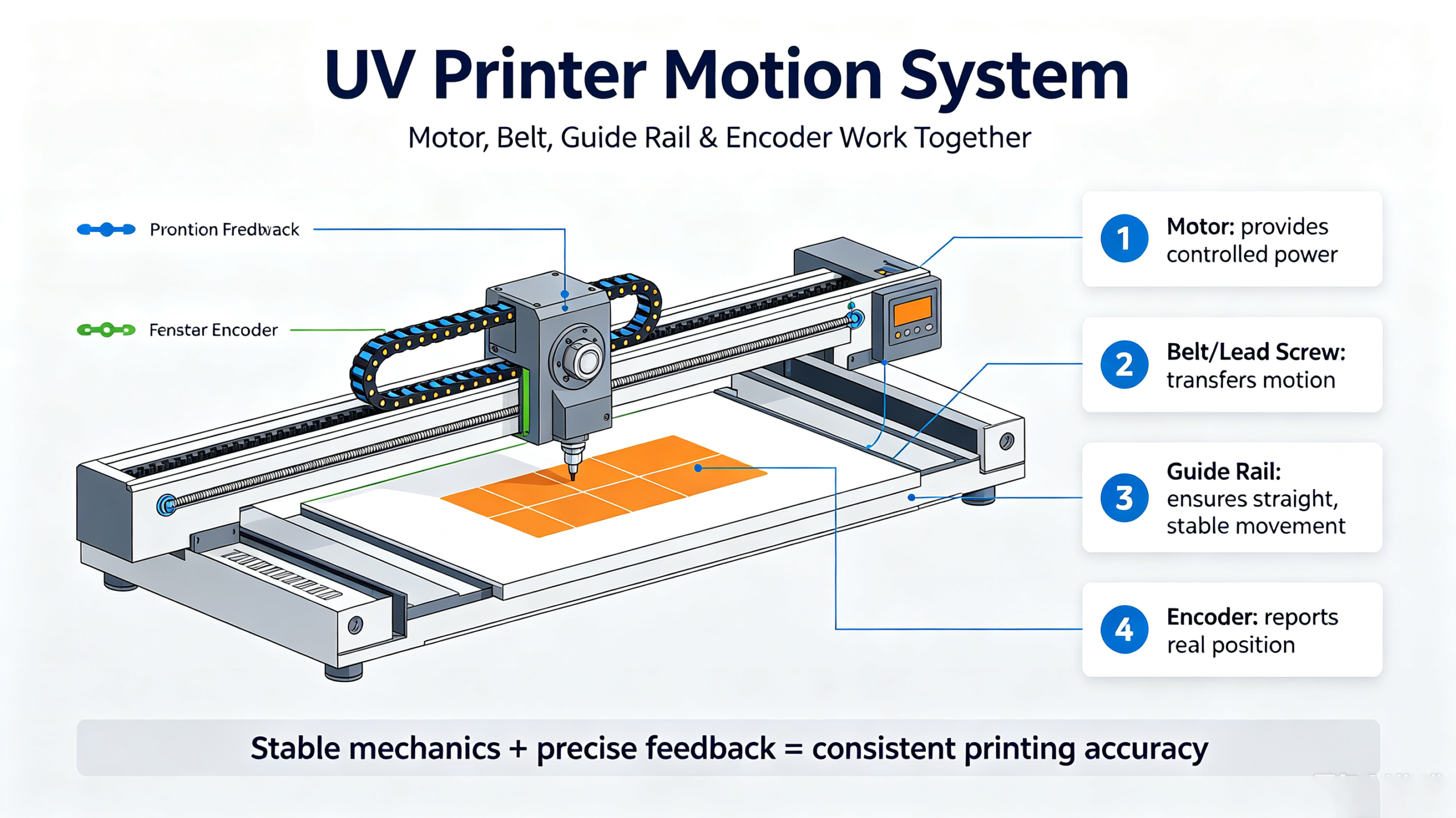
- Motor: The Stable Power Core
Many cheap printers only realize simple “rotate and move” functions. In contrast, industrial-grade UV printer motors support precise programmed operation — accurate control of acceleration, deceleration, running speed, moving distance and stop position.
This is the fundamental guarantee for bidirectional high-speed printing without ghosting. The motor does not work blindly; it executes precise commands from the control system to complete smooth reciprocating movement, eliminating jitter and offset caused by unstable power output.
- Belt & Lead Screw: Efficient & Accurate Power Transmission
Different transmission structures are adopted for different printing scenarios to balance speed and accuracy:
Timing Belt: Equipped with tooth-shaped meshing design, it effectively avoids slipping compared with ordinary belts. It features fast transmission, stable operation and simple structure, perfectly matching the high-frequency reciprocating movement of the printhead carriage, and is the optimal choice for high-speed printing axes.
Lead Screw: Converts rotational motion into linear motion with ultra-high precision, providing stronger thrust and better structural rigidity. It is widely used in platform lifting and precision positioning axes to ensure zero error in material lifting and fine positioning.
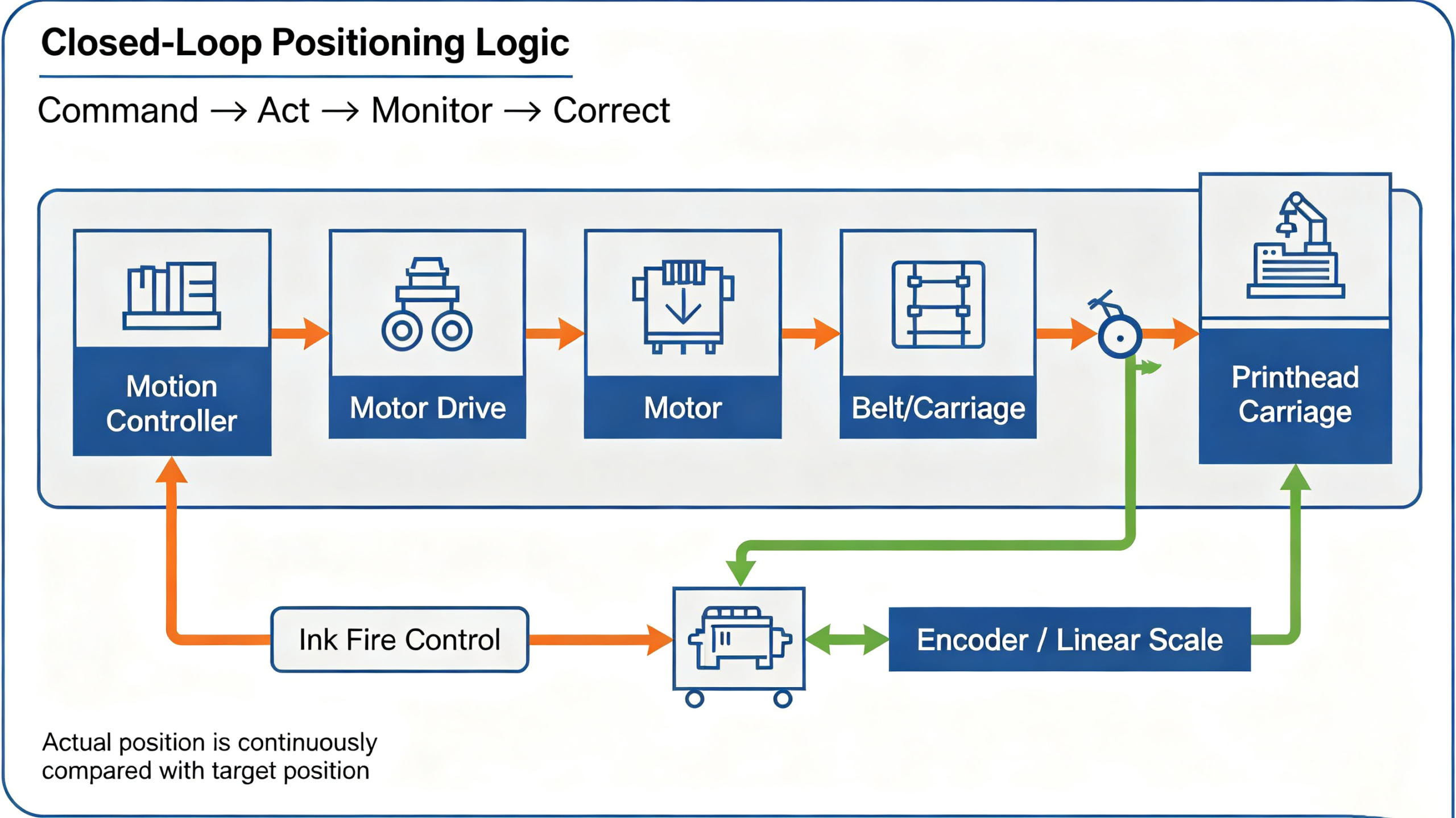
- Linear Guide Rail: Keep Printhead Moving Straight & Stable
Without guide rails, the printhead will swing and shake drastically when moving at high speed, resulting in distorted patterns and blurred details.
High-precision linear guide rails provide a fixed linear trajectory for the printhead carriage, restricting lateral deviation, reducing friction and eliminating running jitter.
Simply put: The motor makes the printhead move; the guide rail makes it move steadily and straightly. It is the key to ensuring consistent printing accuracy for long-term mass production.
- Encoder: The “Eye” of Precision Printing
This is the most critical and easily overlooked core component of the entire precision system.
The control system cannot judge the position only by motor operation data. Belt aging, mechanical gaps and slight friction errors will all causetheoretical position ≠ actual position.
The encoder monitors the real-time position and movement status of the printhead at all times, feeds accurate data back to the system, and the system dynamically corrects the movement deviation. This forms a closed-loop precision control system.
Once the encoder fails or is polluted, it will directly lead to printing misalignment, pattern deformation, size deviation and repeated ghosting — most long-term printing quality problems stem from this.
- Full Working Logic: Speed & Precision Perfectly Unified
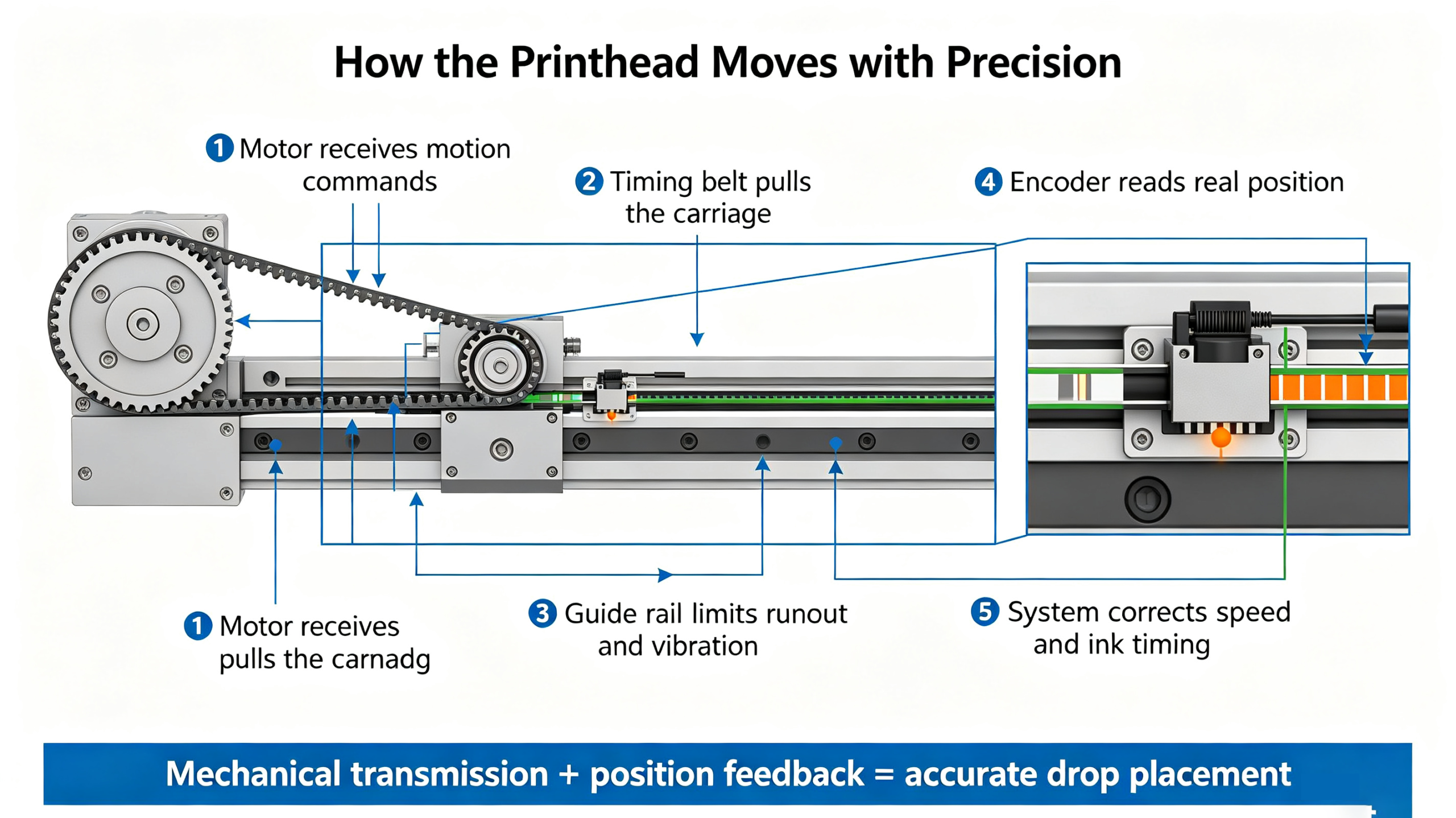
A qualified industrial UV printer operates in a complete closed-loop logic:
Control system issues movement commands → Motor outputs stable power → Belt/lead screw transmits accurate motion → Guide rail ensures linear and stable operation → Encoder feeds back real-time position data → System dynamically corrects deviation → Printhead reaches the precise position and sprays ink synchronously
This integrated mechanical, electrical and control system ensures that high speed does not sacrifice accuracy.
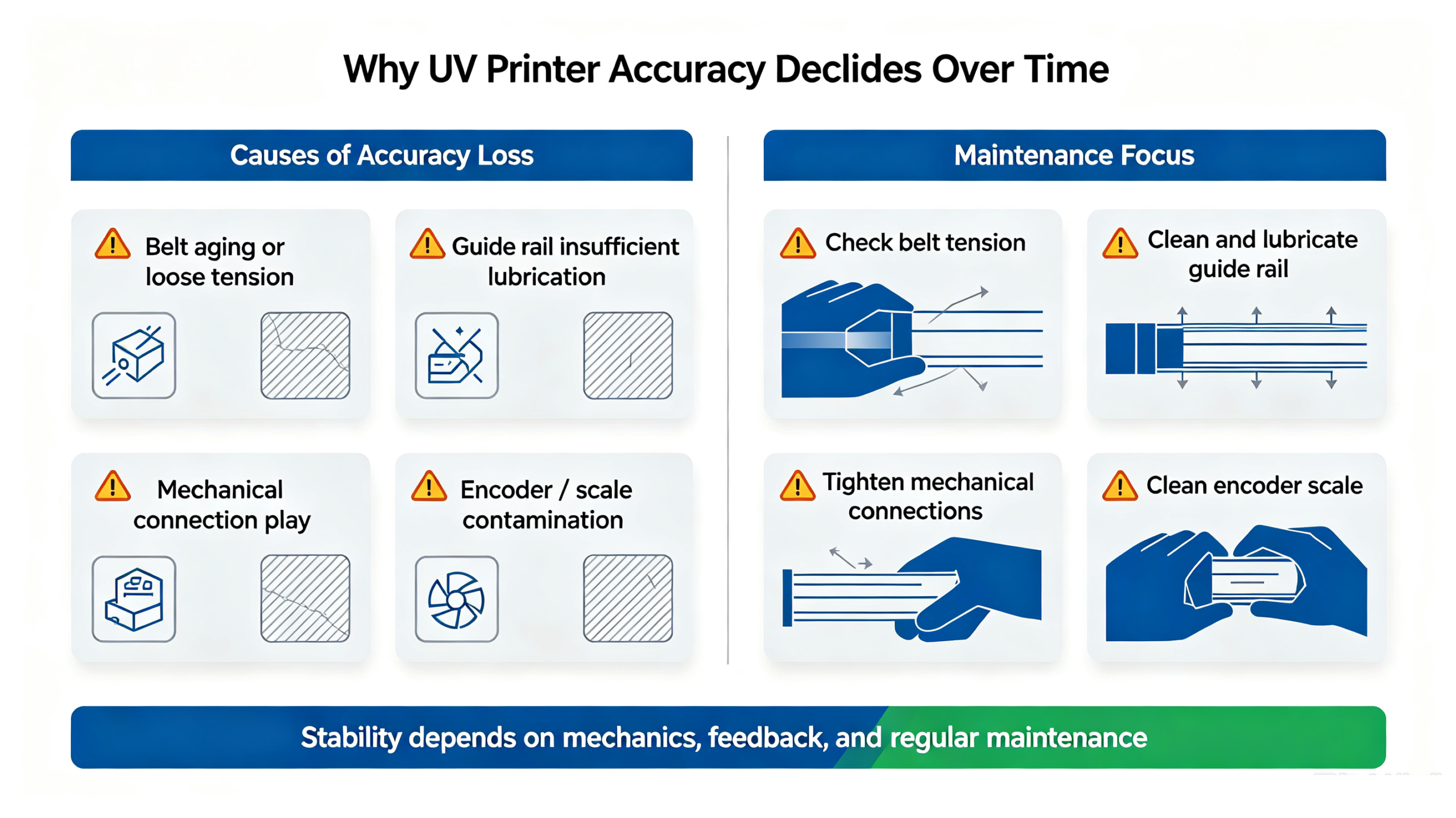
- Why Your Printer Loses Accuracy After Long-Term Use?
Printing quality degradation is not only caused by printhead wear. The aging of the motion system is the main culprit:
- Aging and loose belts leading to slight slipping
- Insufficient lubrication and dust accumulation on guide rails causing jitter
- Loose mechanical connecting parts resulting in positioning gaps
- Dust and ink pollution on encoder affecting data feedback accuracy
Regular maintenance of the motion system is far more important than simple printhead cleaning for stable mass production.
Final Conclusion: Stability Beats Pure Speed
Many suppliers only highlight “ultra-high printing speed”, but ignore structural stability and closed-loop control accuracy.
For industrial printing factories, fast printing with defective products equals low efficiency. What you really need is a UV printer that can maintain high precision, zero ghosting and stable output during long-term high-speed operation.
Looking for a high-stability industrial UV printer with full precision motion system?
We focus on high-precision UV printing equipment, with strict optimization of motor power, transmission structure, guide rail stability and encoder closed-loop control. Support customized solutions for different materials and printing needs, helping you achieve high-speed, high-precision and zero-defect mass printing.
Contact us for machine parameters, test samples and factory inspection!