
If you work in the UV printing industry, you have most likely encountered this frustrating issue: with the same UV printer and identical ink, prints on glass and metal turn out durable and scratch‑resistant. Yet when switching to plastics or acrylics, the printed layer peels off with light scraping, falls off after a few days, or suffers from ink layer cracking.
Most operators tend to blame poor‑quality ink, faulty printheads, or insufficient UV lamp power. While equipment and consumables can affect final results, from the perspective of material chemistry and interface engineering, poor UV adhesion is rarely caused by “insufficient drying”. Instead, it stems from an unstable bonding system between ink and substrate surface.
This article breaks down the underlying science behind firm UV ink adhesion, helping you avoid common pitfalls and resolve peeling and scratch‑resistance failures.
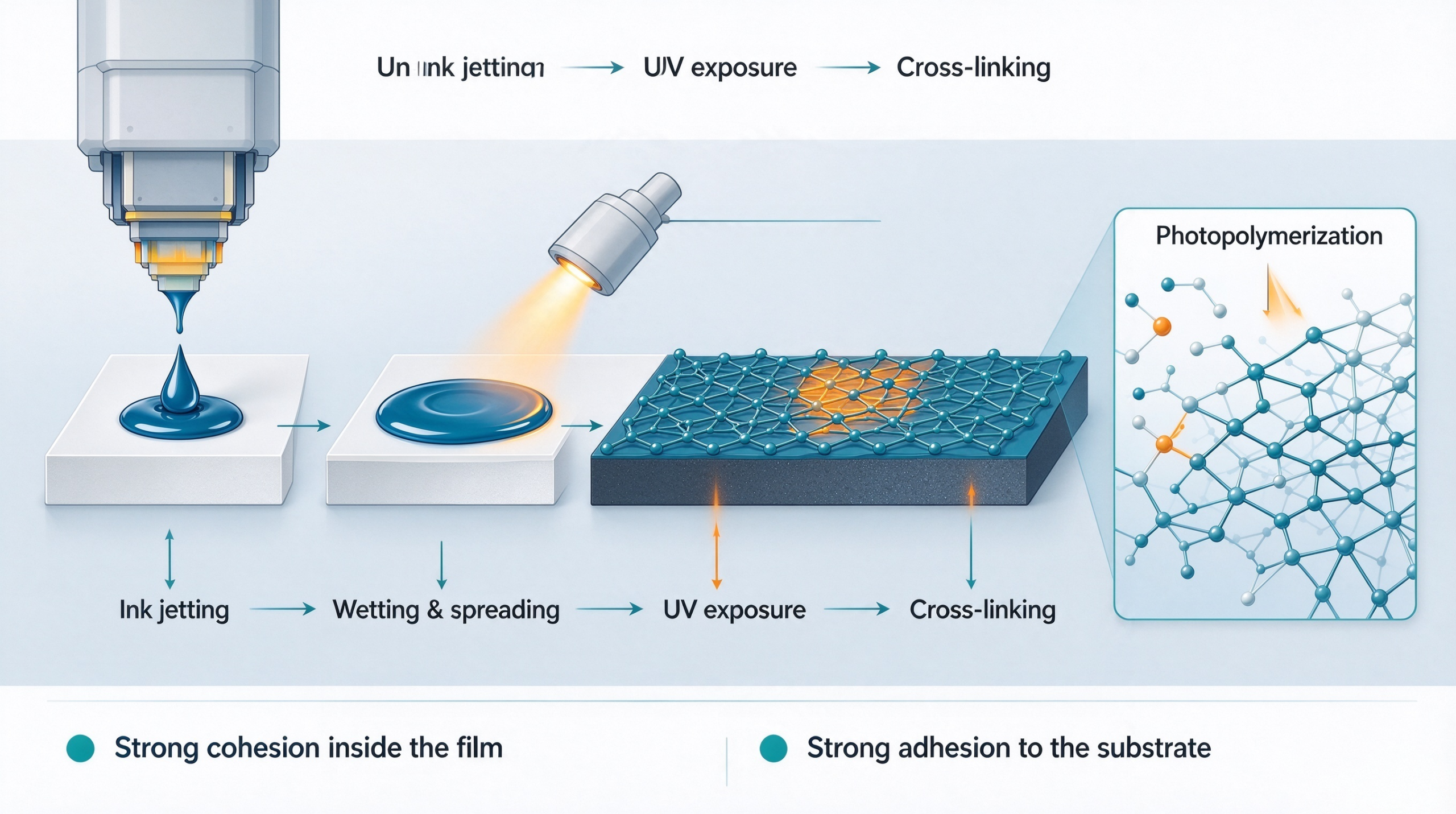
- Redefining UV Curing: Not Drying, but a Polymer Chemical Reaction
Conventional inks dry through solvent evaporation. UV printing follows an entirely different physical‑chemical mechanism, which accounts for its high precision and instant curing.
Complete UV printing & adhesion workflow: Ink droplets are jetted → droplets spread and wet the substrate surface → exposed to UV lamp radiation → photopolymerization is triggered inside the ink → liquid ink cross‑links into a dense, solid polymer ink layer.
Durable, non‑peeling prints require two prerequisites:
- The ink layer itself is fully cross‑linked, hard and structurally stable.
- Firm bonding and interfacial compatibility exist between ink film and substrate.
Failure in either step leads to ink peeling, delamination and weak scratch resistance.
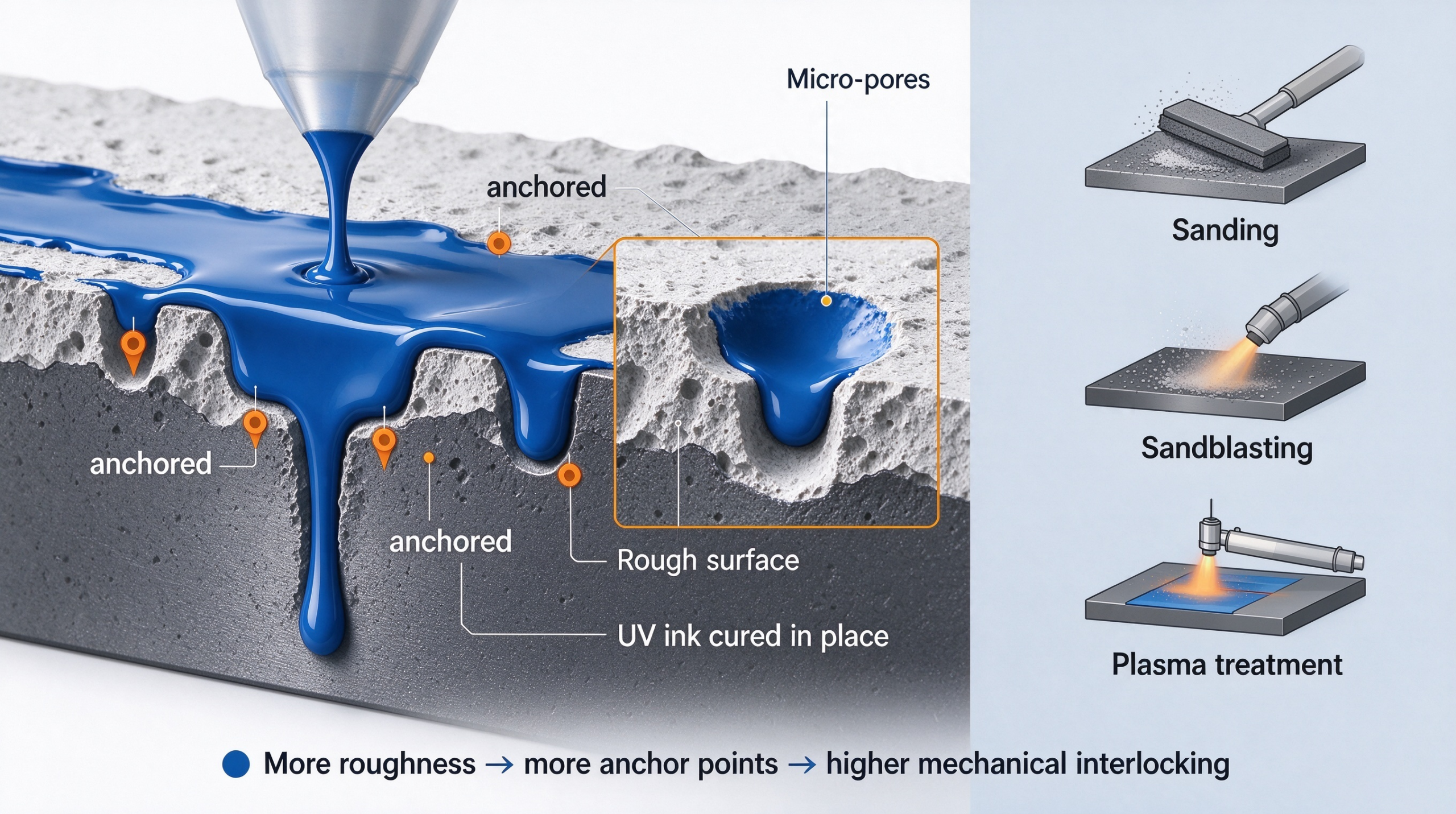
- Two Core Adhesion Mechanisms: How UV Ink Bonds Firmly to Substrates
Long‑term UV ink adhesion relies on mechanical interlocking plus molecular interfacial bonding, applicable to most printing substrates.
2.1 Mechanical Interlocking: Anchoring Effect on Rough Surfaces
Microscopically, metals, frosted boards and many industrial materials feature countless tiny irregularities and micro‑pores. During printing, liquid UV ink flows into these micro‑cavities. Upon UV curing, the solidified ink becomes physically embedded within surface textures, similar to expansion bolts locking onto the base material. This effect is known as mechanical interlocking.
For this reason, surface preparation including sanding, sandblasting and plasma treatment is widely adopted: it creates more micro‑anchor points by boosting surface roughness and significantly improves adhesion. On the contrary, ultra‑smooth substrates such as glass, mirror‑finished metal and high‑gloss plastics offer almost no mechanical anchorage, making physical bonding alone prone to peeling.
2.2 Molecular Interfacial Bonding: Invisible Adhesion for Smooth Surfaces
For smooth non‑textured materials, adhesion heavily depends on surface energy and wettability — the root cause of many printing failures.
Different substrates deliver vastly different surface energy. Glass and metal are high‑surface‑energy materials with highly active surface molecules, capable of generating intermolecular forces (van der Waals forces, hydrogen bonds) with UV ink molecules for tight contact.
By contrast, PE, PP and many high‑gloss plastics are typical low‑surface‑energy substrates. Their surface molecules show very low affinity for foreign substances. Even when printed, ink merely lies on top of the surface without molecular‑level bonding. Although the print looks intact, it can peel off easily with light rubbing — comparable to how adhesive tapes hardly stick to plastic bags.
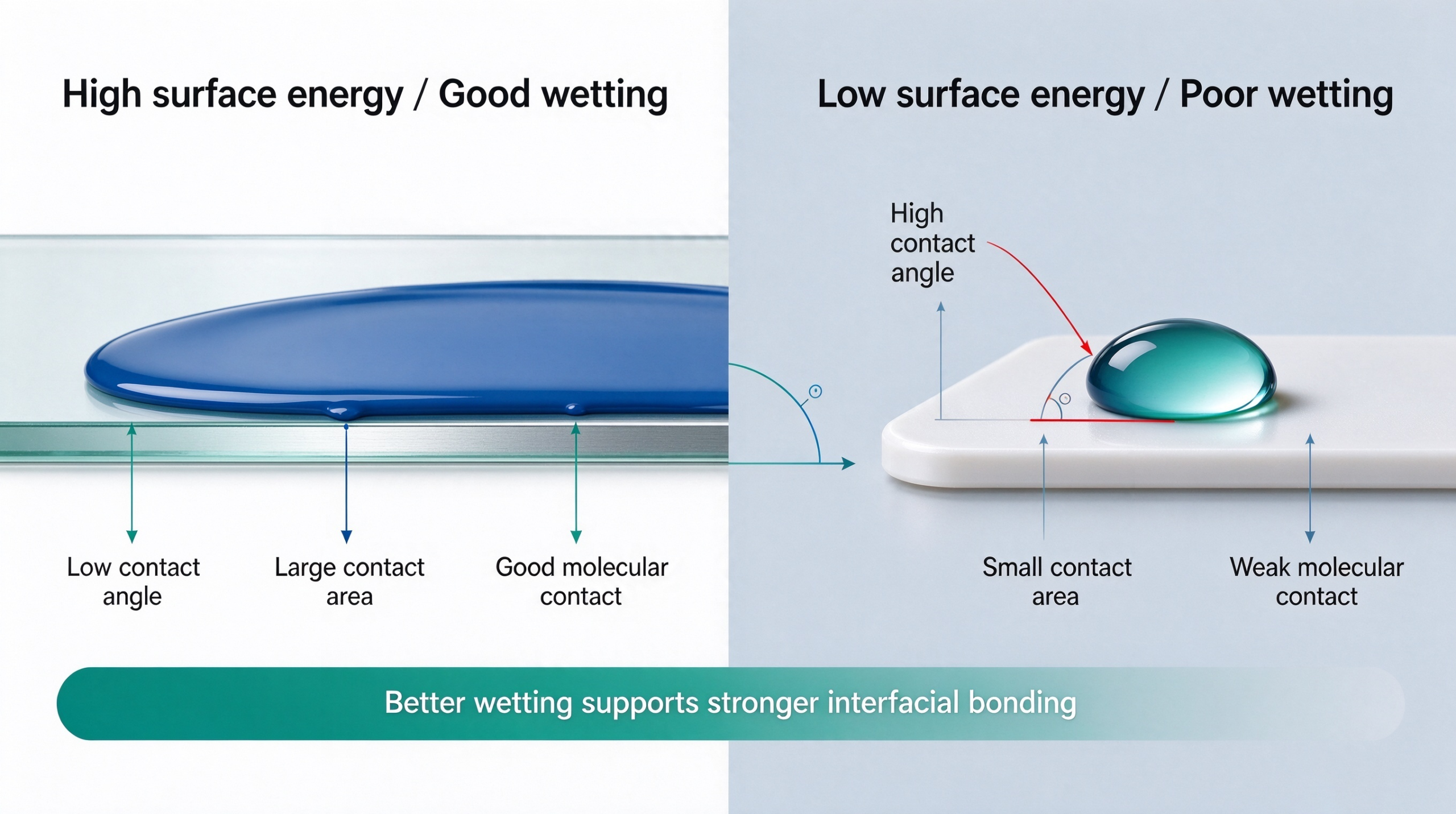
- Wettability: The Foundation of Reliable Adhesion
Wettability can be visualized using water droplets: water spreads evenly over clean glass (good wettability) or beads up into rolling droplets (poor wettability).
The same logic applies to UV printing. Uniform ink spreading without beading or crinkling indicates good compatibility between ink and substrate, low contact angle and maximized contact area — yielding excellent adhesion. If ink contracts into droplets or shows edge shrinkage, insufficient interfacial contact will inevitably cause peeling and flaking later.
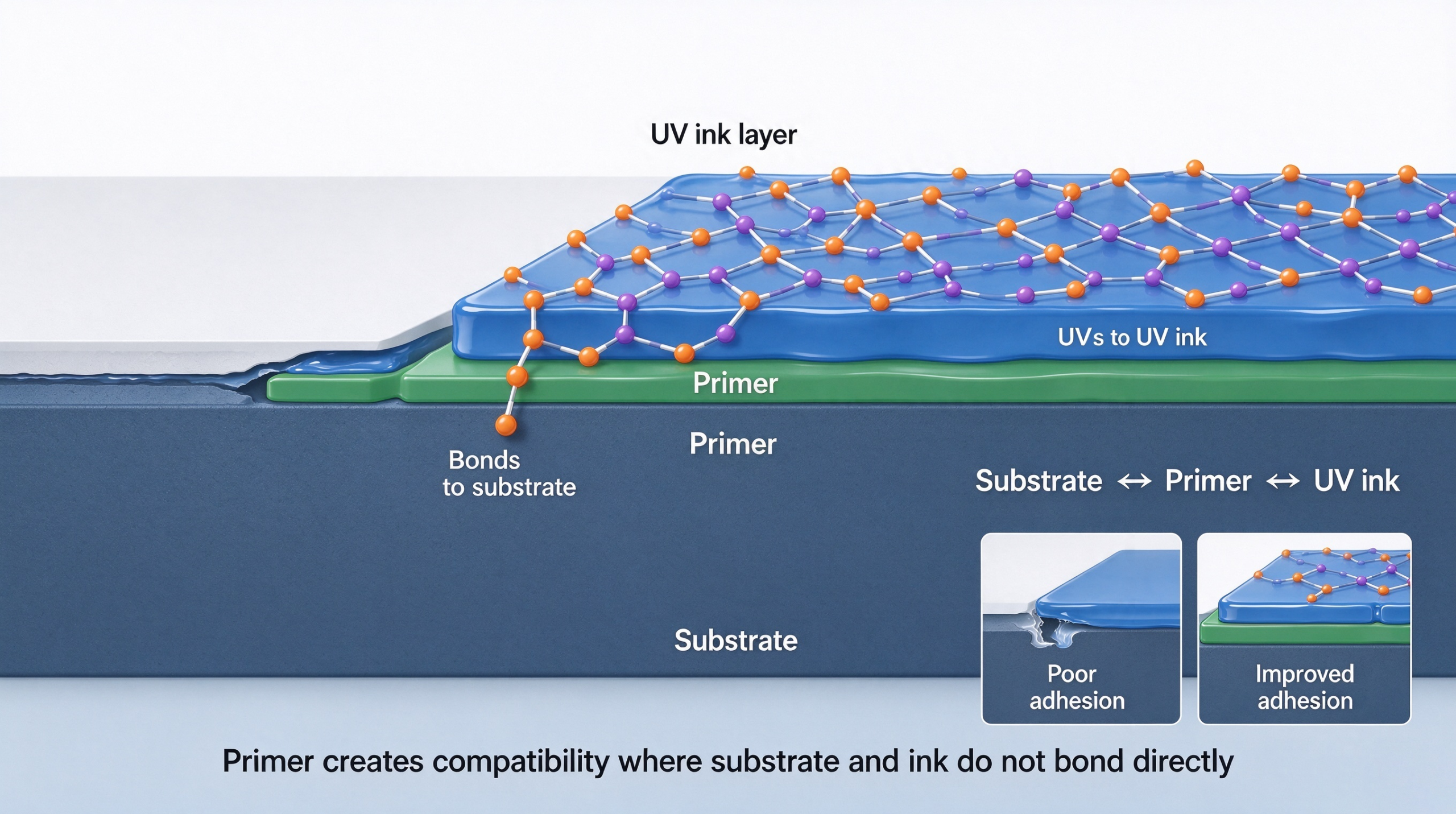
- Primer: The Molecular Bridge for Difficult‑to‑Print Substrates
Many users wonder: why do some operators achieve stable prints on glass or plastic while their own prints keep peeling off? Very often, a primer is the missing component.
A primer is not ordinary glue. It acts as a dedicated connection bridge between substrate and UV ink. One side bonds well with low‑surface‑energy tricky substrates, while the other side co‑polymerizes with UV ink. It solves incompatibility issues between base material and ink.
For challenging substrates such as PP, PE, high‑gloss acrylic and coated glass, applying primer greatly enhances interfacial bonding and effectively fixes peeling and poor wear resistance.
- Why Identical‑grade Materials Deliver Different Printing Results
It is common in the industry that ABS or other plastics from different batches perform very differently, even with the same material designation. The difference lies not in the material name itself, but in surface conditions:
- Migrating additives: Release agents, plasticizers and stabilizers used in plastic manufacturing may migrate to the surface and form an invisible barrier film, preventing direct contact between ink and bulk substrate.
- Differences in surface treatment: Some manufacturers implement corona, flame or plasma treatment to temporarily raise surface activity. Untreated counterparts show drastically reduced adhesion.
- Surface contaminants: Oil, dust, hand sweat and processing residues create barriers that ruin bonding performance.
- UV Lamps Do More Than “Drying”: Critical for Adhesion
Many believe UV lamps only serve to dry ink. In reality, UV energy directly governs ink‑layer stability. UV curing is a photopolymerization cross‑linking reaction requiring adequate and consistent UV energy output.
Insufficient UV intensity or fast printing speed causes incomplete curing. The polymer network remains defective, leaving ink layers soft, tacky and low‑hardness. Prints may look fine at first but scratch off easily over time. Excessive UV energy, however, makes the ink film brittle and crack‑prone. Tuning curing parameters correctly balances hardness and adhesion.
- Practical Troubleshooting Workflow for Ink Peeling
When facing peeling or poor scratch resistance, avoid blindly replacing ink or adjusting machines. Follow this systematic checklist:
- Inspect substrate surface: Remove oil, dust and migrated additives to eliminate isolating layers.
- Characterize substrate properties: Confirm whether it is low‑surface‑energy material; decide if corona treatment or primer application is needed.
- Match consumables: Select UV ink formulated for your specific substrate to avoid material incompatibility.
- Calibrate curing settings: Adjust UV lamp power and printing speed to achieve full curing without brittleness.
Conclusion: UV Printing Focuses on Interfacial Compatibility, Not Simple Color Deposition
Professional UV printing is far more than applying color onto material surfaces. Through material matching, surface pre‑treatment and precise curing, it forms long‑lasting, stable bonding between micron‑thin ink films and diverse substrates.
Equipment, ink, process parameters and substrate surface conditions work together; defects emerge whenever one link fails. With rich experience in UV printing technology, we deliver custom ink matching, process tuning and pre‑treatment solutions for hard‑to‑bond materials. Achieve scratch‑resistant, wear‑proof, long‑lasting prints with consistent color performance on glass, metal, various plastics and decorative materials.