
In the ever-changing field of digital printing, UV-curable inks have become the industry benchmark due to their versatility and durability. However, for print shop owners and DIY enthusiasts, choosing the right type of ink for specific materials remains a challenge.
Using the wrong ink can lead to problems such as leather cracking or glass peeling. In this guide, we will detail the following three main categories: UV inks : hard, soft, and neutral, helping you achieve perfect prints every time.
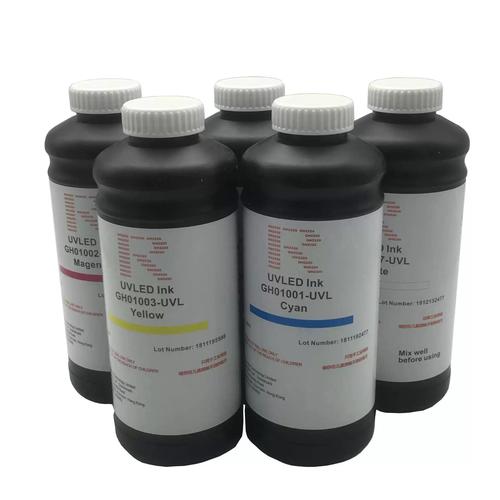
1. Hard UV Inks (Rigid Inks)
Hard UV inks are designed for materials that are highly stable and not easily bent or stretched. After curing with UV light, they form a high-hardness film with excellent scratch resistance and chemical resistance.
Best suited for: non-flexible surfaces.
Main substrates: glass, ceramic tile, metal (aluminum/stainless steel), acrylic sheet, wood and rigid plastic (ABS).
Advantages: * Excellent adhesion to smooth, non-porous surfaces.
High-gloss surface and vibrant color saturation.
Outdoor signage is durable.
Disadvantages: If applied to materials that require folding or compression, it may crack or peel.
2. Flexible UV Inks (Flexible Inks):
Flexible UV inks feature a highly elastic design. Even after full curing, the ink film retains its stretchability, allowing it to move with the substrate without losing its integrity.
Best suited for: materials that need to be bent, stretched or folded.
Main substrates: leather, TPU phone cases, soft PVC, advertising cloth, fabrics and vehicle wraps.
Advantages: * Crack resistance: Can be twisted 180° without breaking.
It is ideal for "squeeze tests" on soft bottles.
It has a soft touch and usually has a matte finish.
Disadvantages: On hard materials such as glass, the adhesion strength may be lower than that of hard inks, which may lead to easier peeling.
3. Neutral UV inks (all-purpose inks):
As the name suggests, neutral UV inks combine hardness and flexibility. They possess both moderate hardness and a certain degree of flexibility.
Best suited for: Printing shops that handle a variety of products and want to avoid frequent ink changes.
Main substrates: rigid plastics, semi-rigid packaging, and some leather products.
Advantages: * Versatility: Reduces the need for multiple printers or expensive ink cleaning.
It exhibits good adhesion to a variety of materials.
Disadvantages: It's versatile, but not an expert in any one area. For extreme applications (such as ultra-brittle glass or highly elastic textiles), specialized hard or soft inks still perform better.
4.Beyond Hardness: Advanced Selection Criteria for 2026
By 2026, simply choosing between "hard" and "soft" will not suffice. To ensure your products meet international export standards, consider the following three technical dimensions:
A. Wavelength matching (365nm vs. 395nm):
Modern UV LED curing systems operate at specific peak wavelengths.
Hard inks typically require higher energy densities to achieve full "deep curing" (complete curing).
Flexible inks are typically surface-cured to maintain their "soft" feel.
If your ink does not match the wavelength of the lamp, you will encounter the problem of "ink tack" (surface tack), regardless of its hardness rating.
B. Low Migration Standards for Packaging
If you are printing on flexible food or toy packaging, you must choose low migration flexible UV inks. This ensures that the photoinitiators used in the ink will not migrate from the substrate to the food or skin, complying with the stringent requirements of the EU REACH Regulation and the Swiss Decree 2026.
C. Surface tension and wettability (dyne value)
Rigid materials (such as glass) typically have high surface energy and require inks with specific dyne values to prevent “beading”.
Flexible materials (such as silicone or treated polyethylene) typically have low surface energy, which can cause ink to peel off.
5.Solution: Using plasma or flame treatment, combined with proper ink classification, is the industry secret to achieving industrial-grade adhesion.
Conclusion: Return on investment for proper ink classification.
Choosing the right UV ink requires striking a balance between durability and versatility.
Use hard inks when the product's lifecycle involves frequent handling or chemical cleaning.
Use flexible inks when the product involves movement, stretching, or contact with skin.
For various promotional gift companies, neutral ink is an economical and efficient "daily staple" ink.