
Many beginners to UV printing share one common misconception: UV printers all use UV ink, so there is not much difference between inks. This is not true. UV ink performance differs drastically depending on substrates, surface treatment and end applications. Even with the same UV ink, prints on different materials will vary greatly in adhesion, color performance and abrasion resistance.
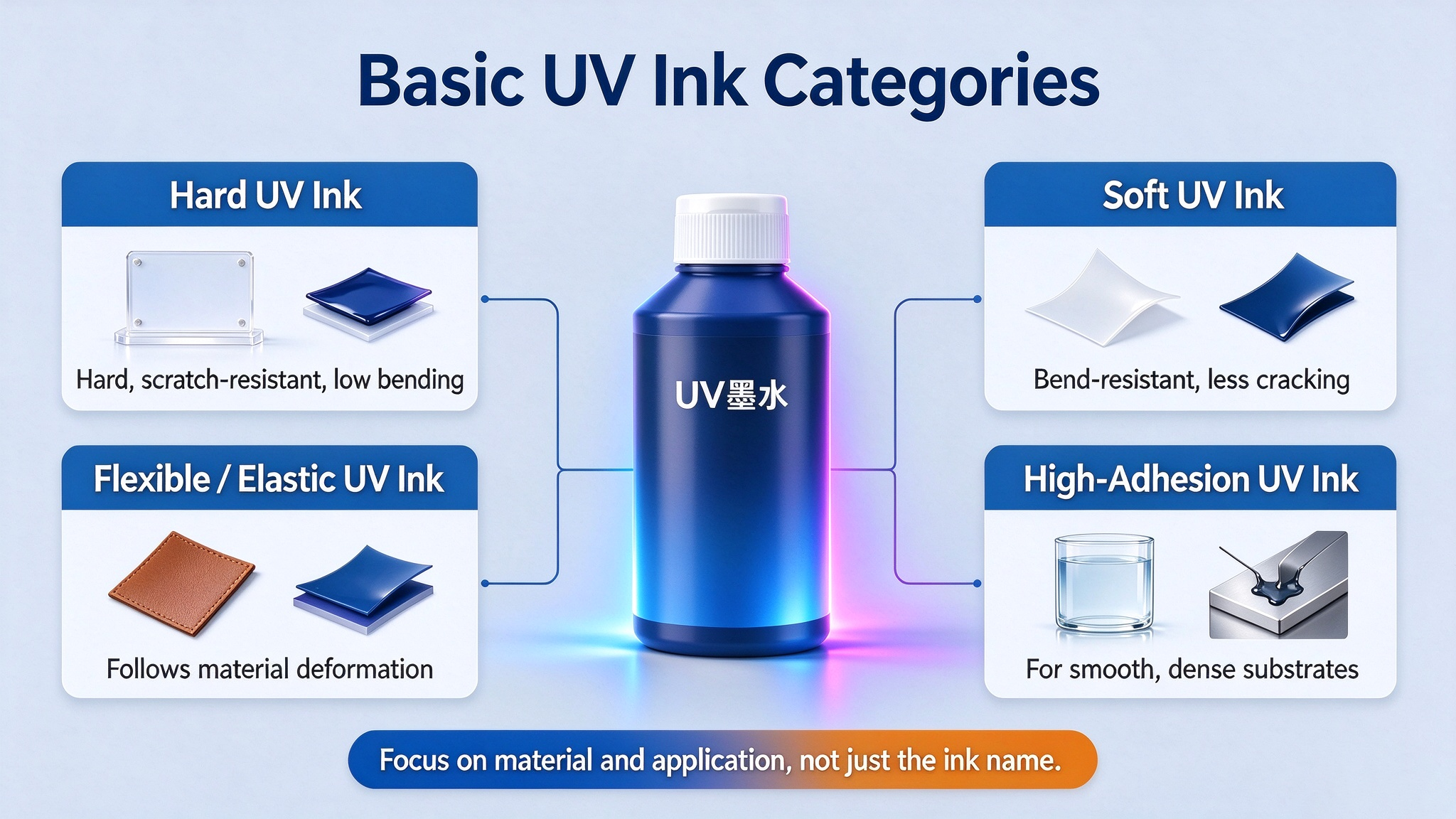
Basic Types of UV Ink
From practical application, UV ink can be divided into four main categories. Note that ink manufacturers may use different naming standards. When selecting ink, always check substrate compatibility rather than product names only.
- Hard UV Ink: Hard ink layer, good scratch resistance, for rigid non-bending materials
- Soft UV Ink: Moderate flexibility, resists slight bending cracking
- Flexible / Elastic UV Ink: High stretchability, suitable for materials with frequent bending or stretching
- High-adhesion UV Ink: Designed for smooth, dense substrates that are hard to bond
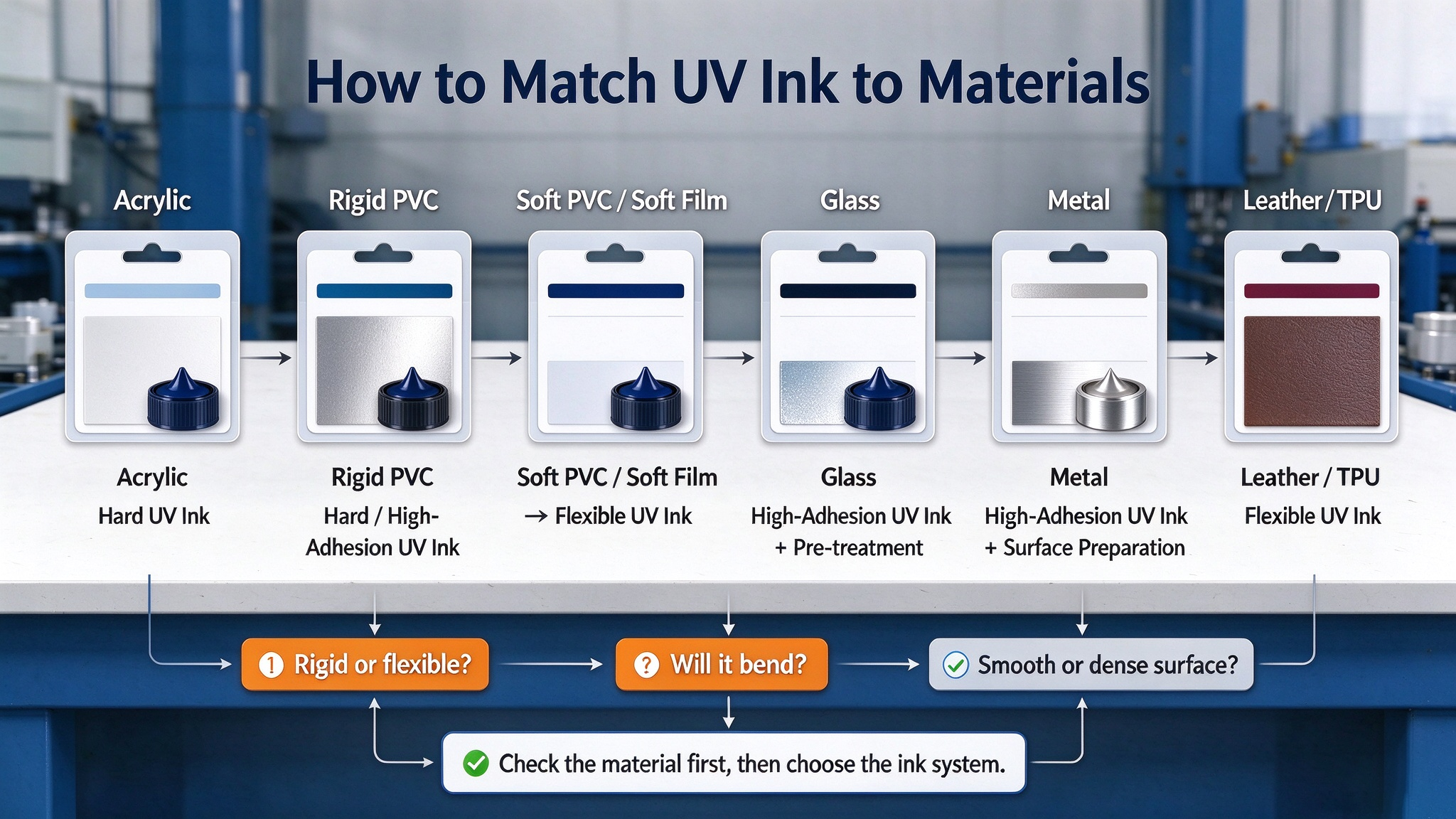
UV Ink Matching for Common Materials
Acrylic (PMMA)
Application: Signage, display stands, letter signs, decorative panels Recommended ink: Hard UV ink Notes: Acrylic from different manufacturers has different surface finish. Always carry out adhesion test.
PVC (Rigid & Flexible)
- Rigid PVC / PVC foam board: Hard or high-adhesion UV ink, focus on adhesion
- Soft PVC: Flexible UV ink. Rigid ink will crack when the substrate bends.
Glass
Application: Decorative glass, nameplates Recommended ink: High-adhesion UV ink / glass-specific UV ink Notes: Glass surface is dense and non-absorbent. Primer and surface pre-treatment are usually required for long-term adhesion. Many glass prints peel off after days due to insufficient adhesion instead of print file issues.
Metal (Aluminum, Stainless Steel, Iron, Metal Nameplates)
Recommended ink: High-adhesion UV ink Notes: Metal surface cannot absorb ink. Printing relies on surface bonding. Surface cleaning or primer coating may be needed.
Wood (MDF, solid wood, plywood)
Recommended ink: Standard UV ink, upgrade to high-adhesion version if needed Notes: Wood has porous surface. Dark wood substrates usually require white ink base to boost color saturation.
Leather & Synthetic Leather (PU / PVC leather)
Recommended ink: Flexible or high-adhesion UV ink Notes: Leather will bend and fold. Hard ink will crack and peel. Always test on your exact leather material.
Phone Cases (PC, ABS, TPU, Acrylic, Silicone)
Do not select ink by the term "phone case". Confirm the raw material first.
- PC / ABS hard cases: Plastic compatible UV ink
- TPU soft cases: Flexible UV ink
- Silicone: Special silicone ink plus primer
Soft Film & Flexible Advertising Materials
Recommended ink: Flexible UV ink. Ink layer needs to deform together with curled or stretched substrates.
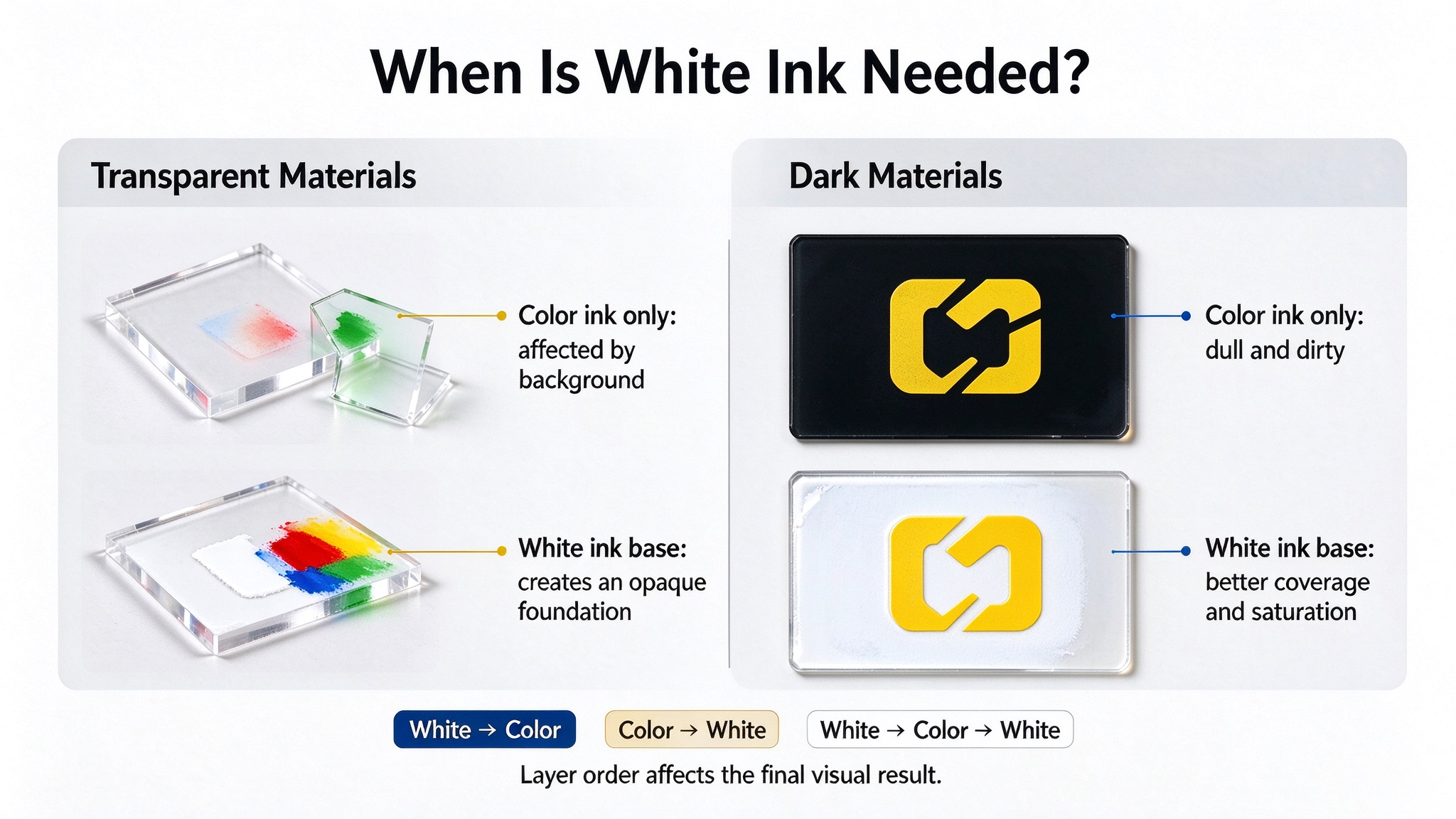
When to use White UV Ink
- Transparent substrates (clear acrylic, glass, transparent plastic): White ink base blocks background interference. Layer options: White → Color / Color → White / White → Color → White. Different sequence brings different visual effects.
- Dark substrates (black acrylic, dark wood): White ink creates a white base for bright and vivid color output, preventing dull color.
Quick UV Ink Reference Table
Substrate | Recommended Ink | Key Concerns |
Acrylic | Hard UV ink | Adhesion, color |
Rigid PVC | Hard / High-adhesion UV ink | Adhesion |
Soft PVC | Flexible UV ink | Flexibility & adhesion |
Glass | High-adhesion / Glass UV ink | Adhesion, primer / pre-treatment |
Metal | High-adhesion UV ink | Adhesion, surface preparation |
Wood | Standard UV ink (high-adhesion optional) | Ink absorption, coverage, adhesion |
PC / ABS Plastic | Plastic matched UV ink | Adhesion |
TPU Soft Material | Flexible UV ink | Flexibility, anti-cracking |
Leather / Synthetic Leather | Flexible + High-adhesion UV ink | Flexibility & adhesion |
Transparent Material | UV color ink + White ink | White ink base, print layer order |
Dark Material | UV color ink + White ink | Coverage, color performance |
Disclaimer: This table is for reference only. Final printing result must be verified with sample test using your substrate, ink model and printer setup.
Why Sample Test Is Mandatory
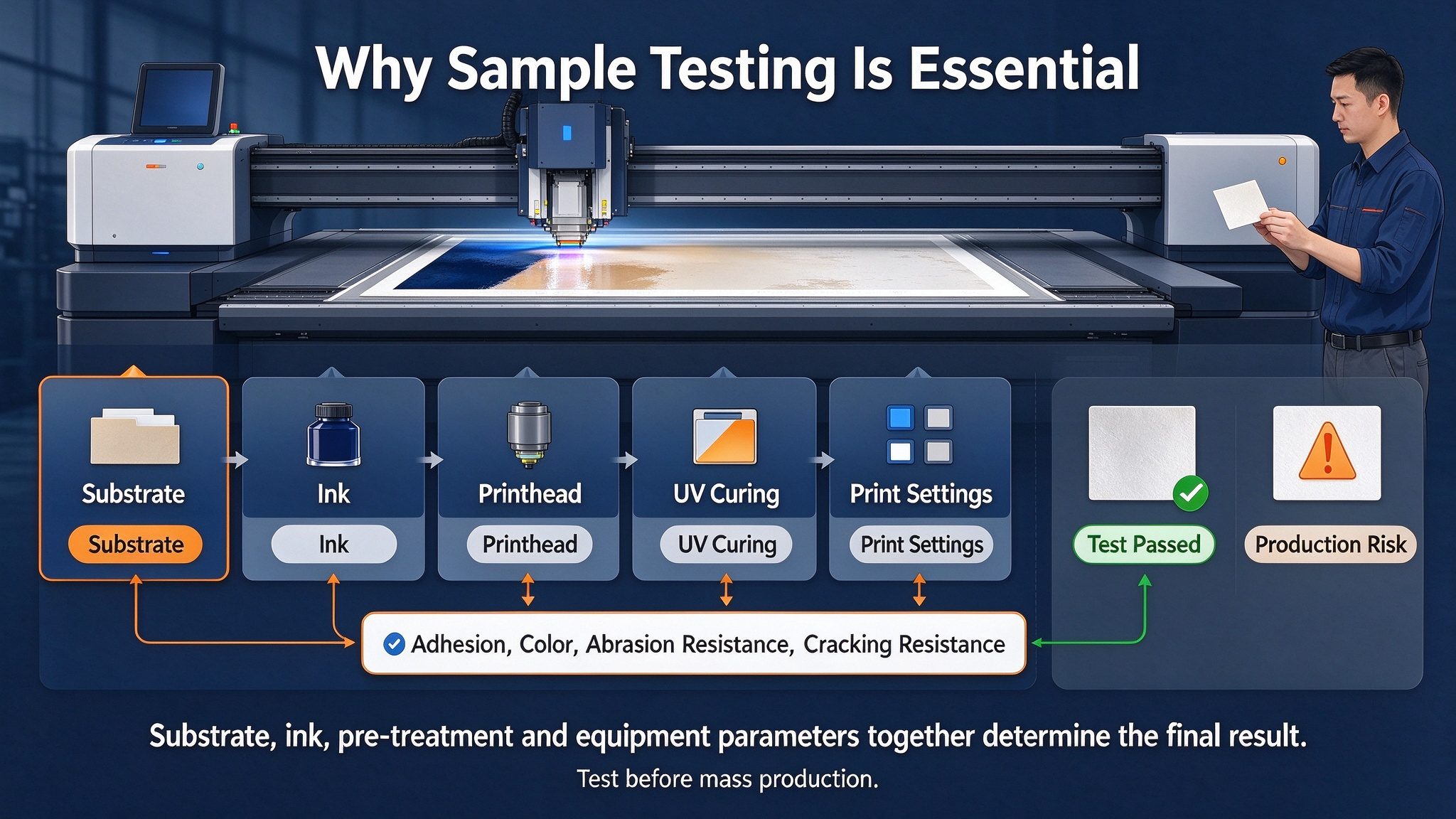
The printing result is not determined by ink alone. It is a combined system: substrate + UV ink + printhead + UV curing power + print settings + surface pre-treatment. The same ink may work perfectly on one brand of acrylic but peel easily on another. Professional service means testing samples first instead of simply saying "it can print".
Conclusion
The logic of UV ink selection is not to memorize fixed ink for fixed products. Step1: Check substrate: rigid or flexible? Will it bend or stretch? Step2: Check surface: smooth & dense or porous? Transparent or dark? Step3: Select hard / flexible / high-adhesion UV ink, add white ink when necessary Step4: Run sample test to verify adhesion, abrasion resistance and anti-cracking performance.
Selecting UV ink is not just purchasing ink barrels. It is to confirm whether the ink works stably with your substrate, printhead and curing system.
TOP Printing provides customized UV ink solutions. Send us your material samples for testing.