
1 How Wetting Agents Lower Surface Tension in UV Inks
Most formulators meet the wetting agent only as one line in a recipe: 0.3 percent, or 0.8 percent, sometimes “as needed”. It is then asked to do a great deal — spread the ink on a difficult substrate, suppress pinholes at the edges of a coating, keep a jetted drop round instead of ragged. And it is usually explained in one sentence: it lowers the surface tension.
That sentence is correct, and it hides everything worth knowing. A small addition changes the surface behaviour of a whole litre of ink, which is counter-intuitive unless you look at where the change actually happens: not in the bulk of the liquid, but in a layer a few molecules thick at its boundary. This article follows that layer, step by step, from the physics of a bare liquid surface to the practical decisions a formulator makes when choosing and dosing a UV ink wetting agent.
Key takeaways:
- Surface tension is a free-energy cost of existing interface, not a property of “softness” of the liquid.
- A wetting agent works by occupying the interface with better-suited molecular segments, so the free energy per unit area falls.
- Because only the interface must be covered, the effective dose is small and saturates; more is not always better.
- Reaching the interface takes time, so the dynamic value — not only the equilibrium value — governs jetting and spreading.
2 Why a liquid has surface tension at all
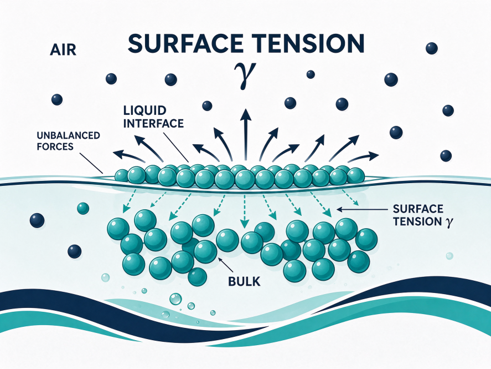
Inside a liquid, every molecule is surrounded on all sides by neighbours. The attractive interactions balance out, and the molecule sits in a relatively comfortable environment. At the surface the situation is different: one side faces air, the other faces liquid. The molecule there has fewer partners to interact with, so the forces acting on it are no longer balanced.
Because of that imbalance, creating a new surface costs free energy. A liquid therefore behaves as if it wants to keep its surface as small as possible — which is why a free drop, with no other force acting on it, settles into something close to a sphere.
This property is described by the surface tension γ, normally expressed in mN/m. Thermodynamically it is the free energy required to create one unit of new interface. Lowering the surface tension therefore means lowering the free energy needed to form and to hold that interface. It does not mean the liquid has become smoother, slipperier or thinner.
3 Why a wetting agent moves to the interface
A wetting agent is interfacially active: its molecular structure contains segments with different affinities for the bulk ink and for the interface. In water-based systems the classic picture is a hydrophilic head plus a hydrophobic tail — soap and detergent being the familiar examples. One part prefers to stay in the water, the other prefers to leave it, so the molecules collect at water–air and water–oil boundaries.
In UV inks this picture is only an entry point. A UV-curable ink is not an aqueous solution: it is a crosslinkable mixture of monomers, oligomers, photoinitiators, pigments, dispersants and several functional additives. Wetting additives used in UV systems are usually silicone-modified, polyether-modified, fluorinated or other organic structures. The accurate statement is narrower and more useful: different segments of the molecule have different affinity for the bulk and for the interface, so the molecule tends to enrich at the interface rather than distribute evenly.
4 What actually changes at the interface
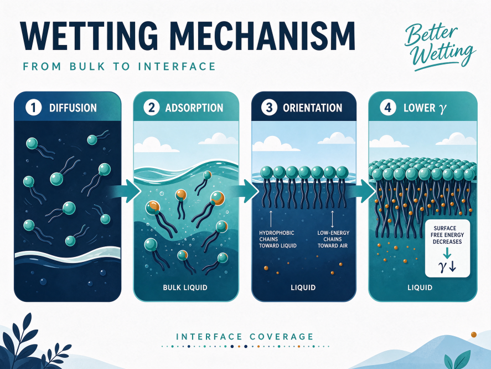
When a suitable wetting agent is added, part of it gradually migrates from the interior of the ink to the interface. Arriving there, the molecules orient and arrange themselves: the segments compatible with the ink stay in the liquid, while the low-energy segments face the air or the substrate.
The interface that previously needed a high free energy to be maintained is progressively taken over by a layer of molecular structure that is better suited to exist there. Free energy per unit area drops, and the value a tensiometer reports drops with it.
This is why describing a wetting agent as something that “makes the ink slippery” misses the mechanism. The decisive change happens in the interface, and it is a change of composition, not a change of the whole liquid.
5 Why such a small dose can have such a large effect
A wetting agent does not need to replace every molecule in the liquid. It only needs to influence the outermost, very thin interfacial region. As long as a certain number of molecules can migrate and enrich at the interface, the composition and energy state of that region change markedly — while the bulk of the ink stays as it was.
As concentration increases, more and more wetting agent occupies the interface and the surface tension usually continues to fall. Once the interface approaches saturation, further additions produce progressively smaller reductions. This is the reason formulations settle on a working range instead of assuming that more always means better: past saturation, the extra material remains in the bulk, contributes nothing to wetting, and begins to cost — in adhesion, recoatability, migration, haze or foam.
6 Getting to the interface takes time: dynamic surface tension
A wetting agent does not reach a newly formed interface instantly. The sequence is roughly: migration and diffusion from the bulk, arrival at the interface, adsorption, then orientation and rearrangement.
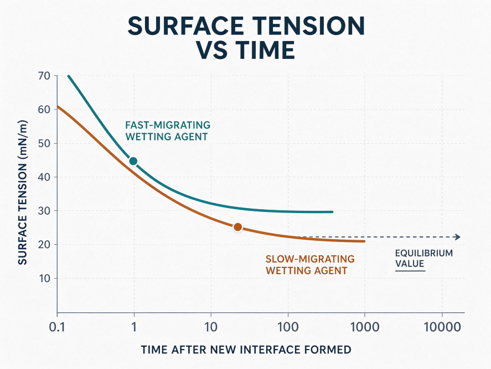
So at the moment a fresh liquid surface is created, little wetting agent has arrived yet, and the measured surface tension may still be high. As time passes, more molecules enter the interface, the value falls, and it finally approaches an equilibrium state. For systems containing surface-active components the surface tension can therefore be written as a function of time: γ = γ(t).
This time dependence is the whole point of dynamic surface tension measurement, and it is routinely underestimated in UV inkjet work, where the relevant timescale between a new interface appearing and the ink having to behave correctly is measured in milliseconds.
7 Why two wetting agents with the same equilibrium value behave differently
Different wetting agents differ in molecular structure, and therefore in compatibility with the ink, solubility state, molecular size, polarity, migration rate, adsorption capacity at the interface and the arrangement they finally adopt.
Two additives can therefore bring the equilibrium surface tension to a similar level while reaching that state at completely different speeds. The endpoint looks identical on a specification sheet, but the state of the interface in the first tens of milliseconds after a new surface forms is not the same at all — and that early state is what governs droplet formation, spreading and defect formation.
This is also why a single static surface tension number sometimes fails to describe a material state adequately in fast dynamic processes.
8 How to read the hydrophilic–lipophilic balance in UV systems
For classical surfactants, the ratio of hydrophilic to lipophilic structure in the molecule influences which phase it prefers, how readily it migrates to an interface, on which interfaces it is most effective, and what adsorption structure it finally forms. That logic remains useful as a starting point.
In a complex UV ink, however, the final result cannot be predicted from “more hydrophilic segment or more lipophilic segment” alone. Performance is also shaped by the monomers, oligomers, pigments and other additives in the system, and by the specific chemistry of the wetting agent itself. The more defensible reading is this: molecular structure determines how the molecule partitions between bulk and interface, and that partitioning behaviour ultimately determines its interfacial effect.
9 A familiar illustration: why soapy water makes bubbles
Pure water has a high surface tension. Add soap or a surfactant and the surface-active molecules enrich at the water–air interface, lowering the surface tension. The interfacial film that forms also helps a thin liquid film hold together, so soapy water forms and sustains bubble films far more easily than pure water.
Bubble stability also involves film elasticity, drainage and the Marangoni effect, so the example is deliberately simplified. It is used here for one purpose only: to show how surface-active molecules change the properties of a liquid surface.
10 Back to UV inks: new interfaces are created all the time
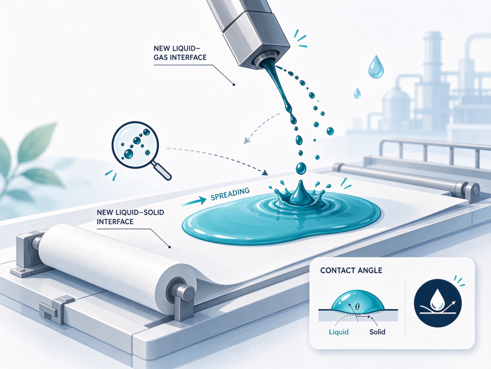
In UV inkjet printing, the same interfacial process is continuously at work. During jetting, the liquid column stretches and breaks, creating new liquid–gas interfaces again and again. When the droplet lands on the substrate, a new liquid–solid interface is formed. In both cases, what matters is not only the value a laboratory tensiometer reports for the bulk ink, but how quickly the wetting agent can reach each new interface and how it changes the interfacial state at that moment.
That is why dynamic surface tension deserves attention in inkjet systems, and why selecting a UV ink wetting agent on the equilibrium value alone can lead to a formulation that looks correct in the laboratory and behaves poorly on the press.
11 What this means in the formulation lab
The mechanism above translates into a small number of practical decisions.
- Dose by titration, not by habit. Start from a low level and measure the change in surface tension and contact angle at each step; the useful dose is usually the point just before the curve flattens, not the level copied from another formula.
- Measure the dynamic value for inkjet work. An equilibrium value describes a state the ink may never reach during jetting or drop impact; a dynamic curve describes what the drop actually experiences.
- Respect the saturation point. Above it, added wetting agent stops improving wetting and starts affecting adhesion, recoatability, surface slip and migration behaviour.
- Test on the real substrate. Liquid–gas and liquid–solid interfaces are different problems: one governs atomisation, droplet shape and levelling, the other governs how the ink meets a specific film, foil or plastic.
12 Conclusion
The mechanism of a UV ink wetting agent can be reduced to a short chain: the additive is present in the bulk of the ink; a new interface forms; the molecules migrate, adsorb and orient; the composition and free energy of the interface change; the surface tension falls.
Add the dimension of time to that chain and you arrive at dynamic surface tension. Once the chain is understood, the wetting agent is no longer just a percentage in a formulation table. What it changes is the interface of the ink — and that interface is where print quality is decided.