
A common headache for UV inkjet engineers: two UV curable inks test nearly the same viscosity at the operating temperature, but perform completely differently on the same piezo printhead. One produces clean, consistent droplets; the other suffers from long tails, satellite droplets, drop velocity variation, and gradually missing nozzles after continuous running.
Many operators treat viscosity as the final pass/fail standard for jettability. However, in industrial UV inkjet applications: matched viscosity does NOT equal stable jetting. Viscosity is only a primary screening metric, not the full answer to jetting reliability.
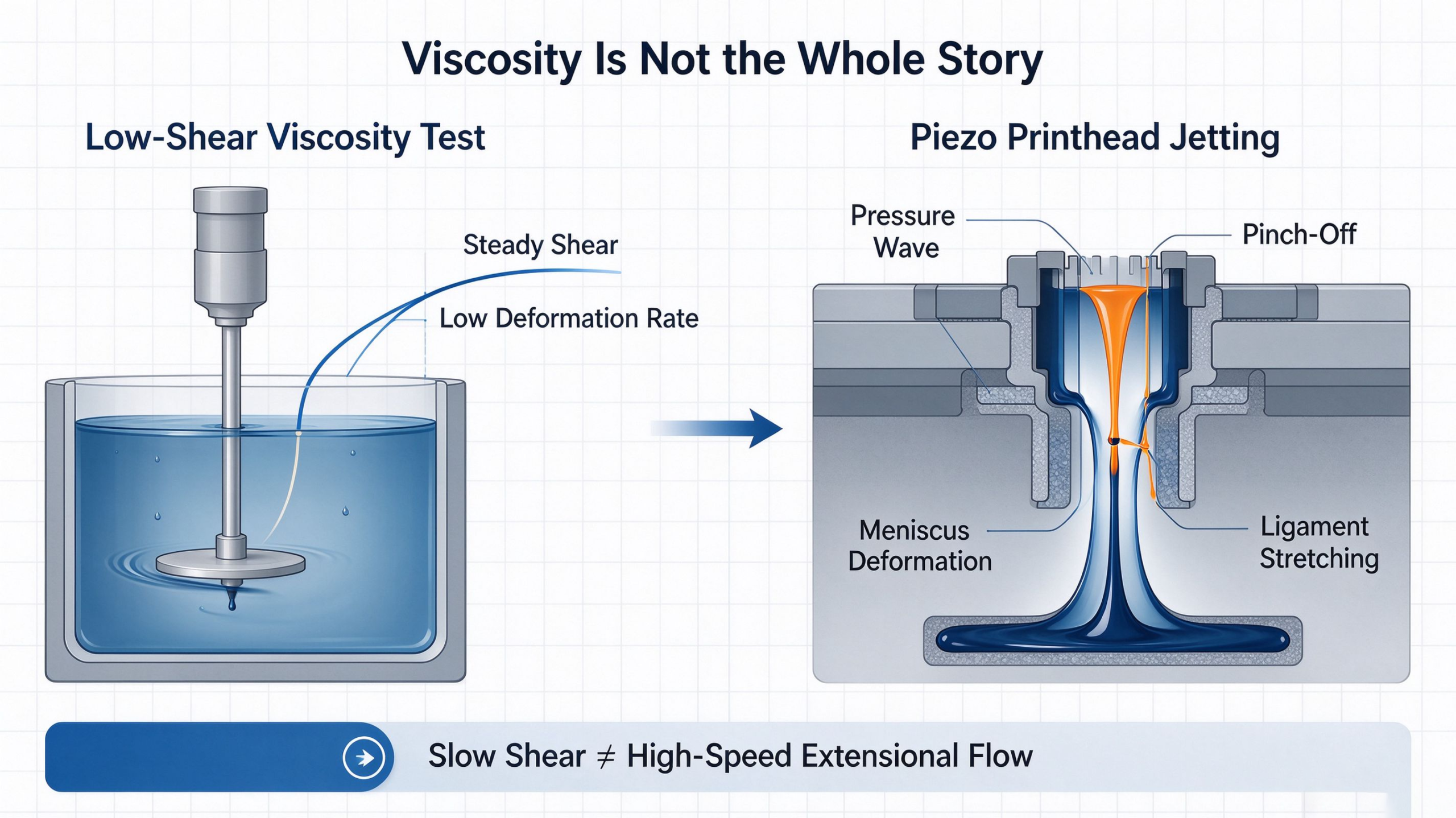
What does single-point viscosity really tell us?
Viscosity measures a liquid’s resistance to steady shear flow. It is the first parameter checked for UV ink qualification. Too high viscosity makes the printhead struggle to push droplets; too low viscosity may cause dripping and ink mist. This is why formulators and print shops always verify viscosity within the printhead manufacturer’s recommended temperature window.
Standard viscosity tests run under slow, steady shear. Inside a piezo printhead, the ink undergoes microsecond-scale dynamic events: pressure wave propagation, meniscus deformation, ligament formation, extensional thinning, pinch-off and meniscus recovery. This is high-speed extensional deformation, far different from the low-shear test condition of a viscometer.
A single viscosity value only describes flow resistance under slow shear. It cannot capture elastic response, relaxation time or pinch-off behavior when the ink ligament is stretched rapidly.
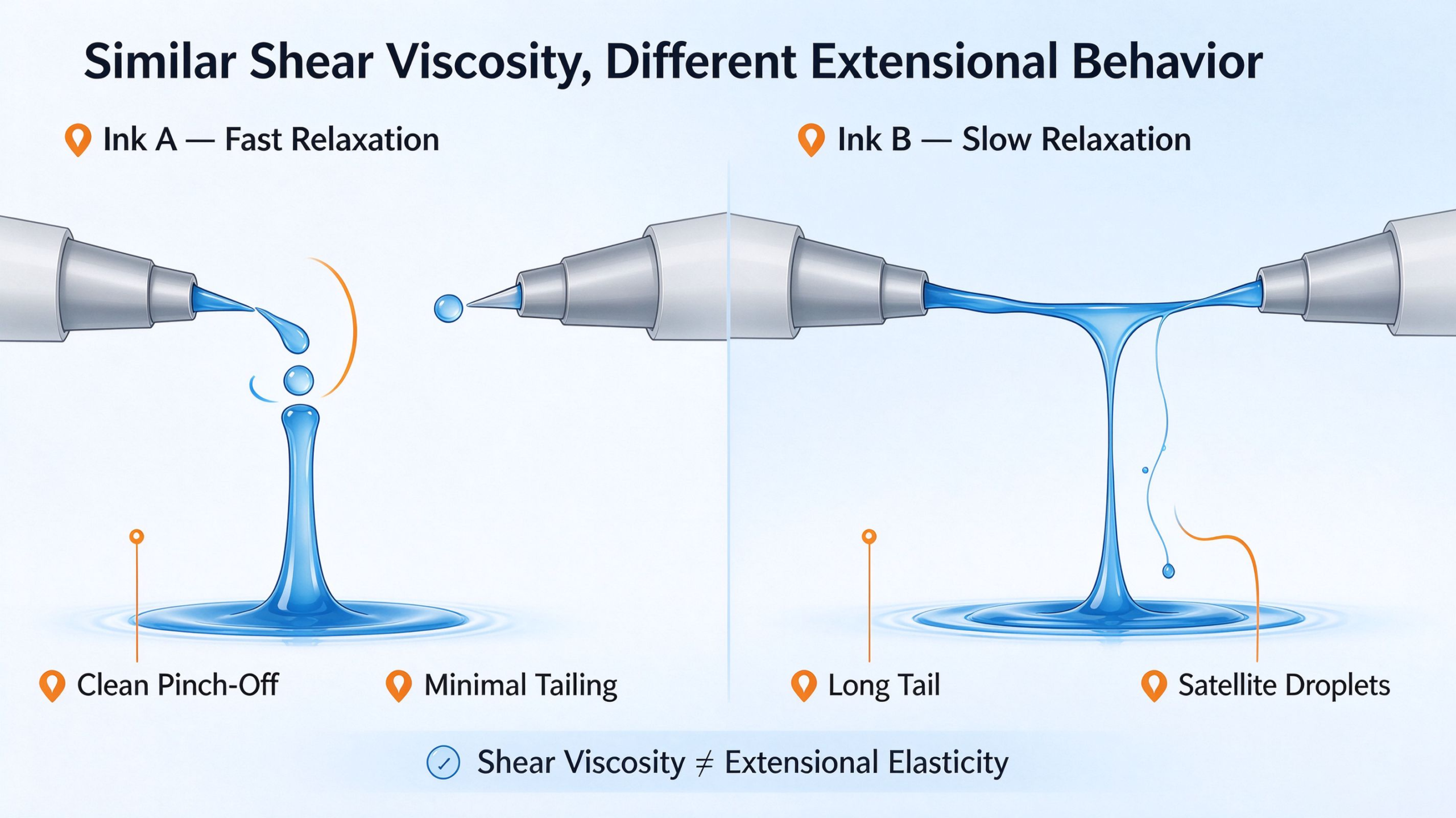
Similar shear viscosity does not mean identical rheology
Two inks can match in shear viscosity at the set temperature while having totally different molecular architectures. One ink may use low-monomer, low-elasticity oligomers that relax quickly after stretching, resulting in clean ligament pinch-off with minimal tailing. The other ink may rely on long-chain, highly elastic resins, then dilute with monomers to hit the same static viscosity reading. Their viscosity curves overlap at low shear, but elasticity differences dominate once the ligament stretches at jetting speed. High elasticity and slow relaxation delay pinch-off, creating tails and satellite droplets.
This is the key distinction in inkjet science: shear viscosity ≠ extensional rheology. Many formulation failures come from only matching viscosity while ignoring high-speed extensional elasticity.
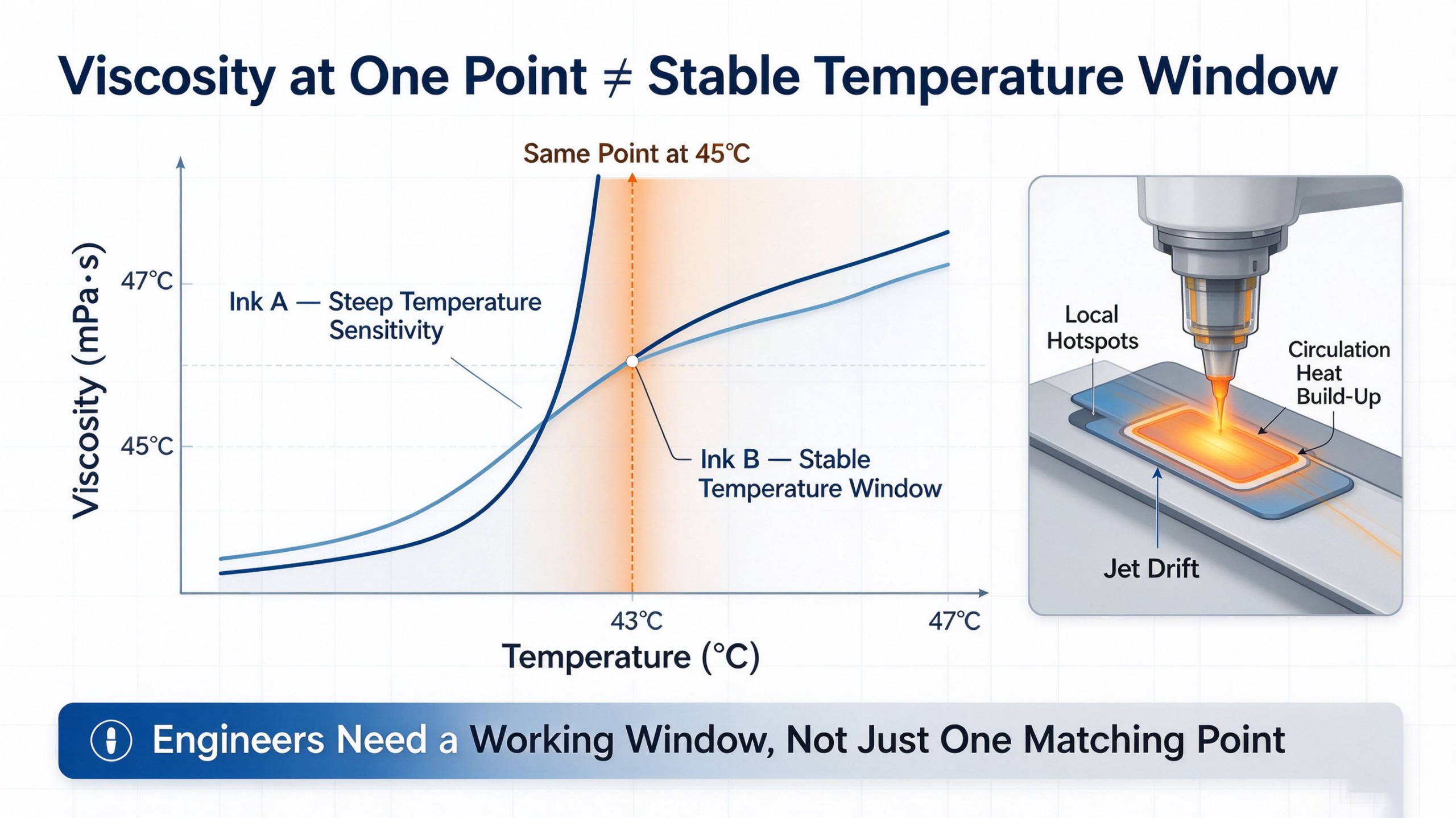
Matched viscosity at one temperature does not guarantee a stable temperature window
Matching viscosity at 45°C does not guarantee the same viscosity at 43°C or 47°C. UV ink formulations vary widely in temperature sensitivity. Some inks feature a flat viscosity-temperature curve and tolerate minor temperature drift; others are highly temperature-sensitive. Local hotspots inside the printhead, heat buildup from circulation and warm-up cycles shift their actual rheology rapidly, leading to jet drift and nozzle drop-out during long runs.
For mass production, engineers need a stable working window around the target temperature, not just one overlapping viscosity point.
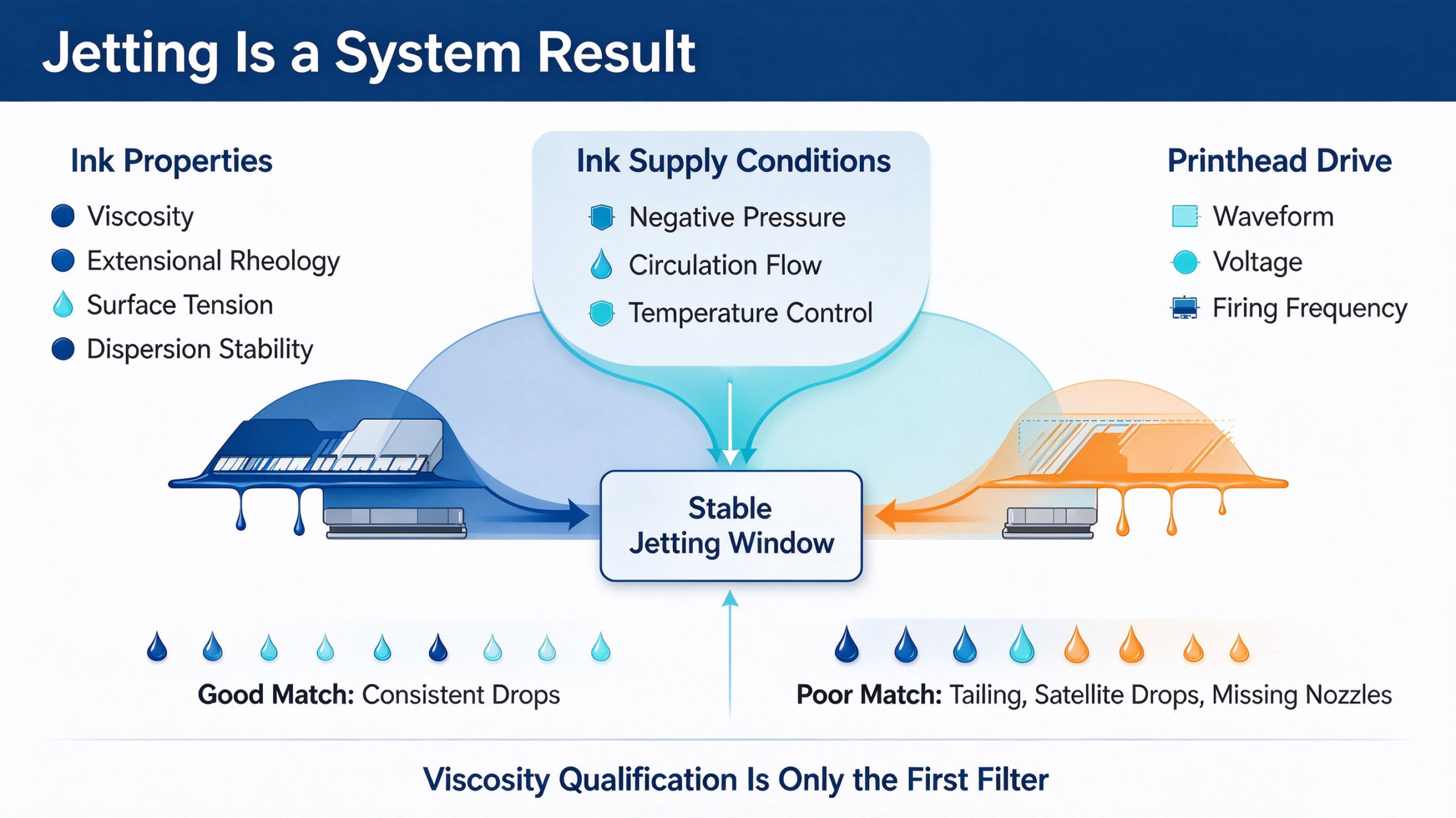
Jetting is a system result, not controlled by viscosity alone
Jetting performance is determined by the combined system: ink rheology properties + supply boundary (negative pressure, circulation flow) + printhead drive conditions (waveform, voltage, firing frequency).
Even with matching viscosity and extensional behavior, differences in surface tension, dynamic interfacial tension, density, pigment dispersion and nozzle wetting balance alter the meniscus and droplet formation. The same ink can produce clean or unstable jets simply by changing the drive waveform or firing frequency. Two inks with close viscosity will respond differently to the same waveform setup.
How to use viscosity properly in daily engineering
Viscosity remains essential as the first filter to reject out-of-spec inks. But if viscosity is already aligned and jetting defects persist, further tuning viscosity rarely solves the root cause. Follow this troubleshooting sequence:
- Map full viscosity-temperature curve and evaluate temperature tolerance
- Record ligament, pinch-off, tailing and satellite droplets via high-speed camera
- Test drop velocity consistency across different firing frequencies
- Run long-duration continuous jetting test to check for drift and precipitation
- Optimize printhead waveform, negative pressure and ink circulation
Conclusion
The reason similar-viscosity UV inks jet differently is not that viscosity is useless. It only describes steady shear resistance. Stable UV inkjet performance depends on extensional rheology, temperature sensitivity, interfacial properties, plus ink supply and printhead waveform tuning.
Matching bulk physical values does not guarantee identical jetting behavior. The real acceptance criterion is consistent jetting under real production conditions, not a viscosity report.
TOP Printing specializes in UV ink formulation, printhead compatibility and inkjet process optimization for industrial UV digital printing.