
Ask a pressroom what the surface tension of a UV inkjet ink should be, and the answer usually arrives as a direction rather than a number: lower. Lower so the ink wets the substrate, lower so the dots spread, lower so the print looks solid.
That direction is half right. The other half is where the money goes. In a UV inkjet printer, surface tension does two different jobs — one at the nozzle, one on the substrate — and those two jobs do not want the same number. Push the value down to satisfy the second, and you start paying for it in the first.
This guide looks at what the parameter actually controls, why a lower value can destabilise jetting, how to judge spreading by measurable output instead of by how wide a drop looks, and how to test surface tension inside your own print system rather than on a data sheet.
One Parameter, Two Jobs
Surface tension is the force a liquid surface exerts to keep itself small, measured in millinewtons per metre (mN/m). A falling droplet becomes a sphere for the same reason a soap bubble does: the surface is always trying to reduce its area.
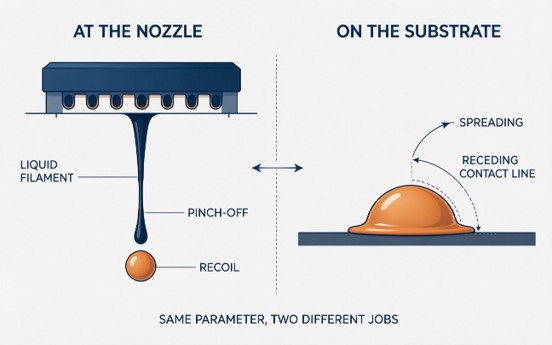
Inside a printhead, that same force is doing structural work. In the microseconds after a pressure pulse, the ink column stretches out of the orifice, forms a neck, and then pinches off. Surface tension takes part in all three steps, and it sets how much energy the drive waveform has to supply.
On the substrate the force changes employer. Now it works against the solid: the balance between the ink's own surface tension and the substrate's surface energy decides whether the contact line advances, holds, or retracts. That balance is what people mean when they say an ink "wets well", although wetting is a relationship between two materials, not a property of the ink alone.
Same number, two jobs. A change that helps one stage is rarely neutral for the other.
At the Nozzle: Surface Tension Does Not Reward the Lowest Number
Droplet formation is not a single-variable problem. It is the joint result of viscosity, density, surface tension, nozzle geometry, waveform, voltage and frequency. Move one of them and you move the operating point of all the others.
The counter-intuitive part is the direction of the breakup. A stretched ink filament pinches off through a capillary instability known as Plateau–Rayleigh breakup, and the growth rate of that instability scales roughly with the square root of surface tension divided by density and radius. Lower surface tension therefore means a slower breakup, not a faster one. The filament stays intact for longer, the tail is longer, and the surplus liquid has more time to detach as a satellite droplet. Long tails are one of the mechanisms behind misting around the head.
The standard way to place an ink inside the printable window is the dimensionless Z number, Z = √(ρσD) / μ, where D is the nozzle diameter, μ the viscosity and σ the surface tension. Inkjet windows are commonly quoted as roughly 1 to 10. Because surface tension enters under a square root, halving it moves Z by only about 1.41× — but that can be enough to walk an ink off the edge of a window it was comfortably inside before.
The second nozzle-side risk is wetting the wrong surface. If the ink's surface tension falls far enough that it also wets the nozzle plate coating, an ink film creeps across the plate face and changes the effective shape of the orifice. Subsequent jets deflect, neighbouring nozzles can be affected, and the face looks flooded. The engineering target is not a low number on the data sheet; it is a large enough contact-angle contrast between the ink and the nozzle plate.
On the Substrate: Surface Tension Sets the Spread, Not the Quality
Lowering surface tension genuinely helps on low-energy substrates — certain plastics, coated metals, films that have lost part of their surface treatment. When wetting is the bottleneck, this is the lever that works, and pretending otherwise helps nobody.
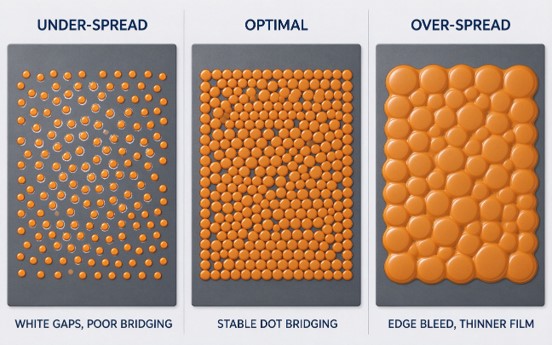
But the goal is not maximum spreading. It is spreading that lands inside a narrow band: wide enough that neighbouring dots bridge into a continuous film, narrow enough that edges stay edges and film thickness stays predictable.
Under-spread shows up as pinholes, white gaps and weak bridging between passes. Over-spread shows up as edge bleed, wider lines, merged fine features, and a thinner film per unit area, because the same volume of ink now covers more ground. In extreme cases the ink dewets locally and leaves a mottled surface that no amount of additional ink fixes cleanly.
Which is why the judgement should be made on measurable output — dot diameter at a fixed waveform, line width on a test pattern, bridging between adjacent dots, film weight per area after cure — rather than on the impression that a drop spreads nicely.
Static and Dynamic Surface Tension Are Not the Same Number
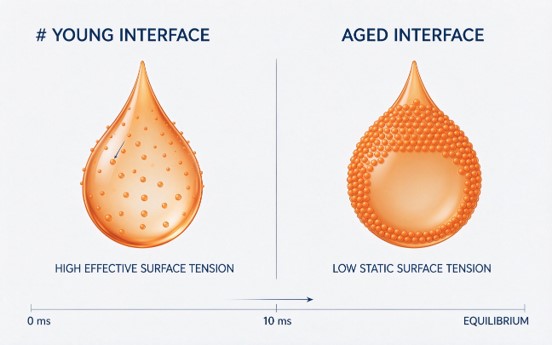
Most wetting additives do not arrive at the interface instantly. They have to travel from the bulk of the liquid to the newly created surface and accumulate there. Given enough time, they get there, and the measured value settles at a low equilibrium number.
A jetting event does not give them that time. The interface is created in microseconds at the nozzle and again at impact, so the value that actually governs the drop is the one that exists at a surface age of roughly one to ten milliseconds — not the equilibrium value read from a bench tensiometer twenty minutes later.
Two inks can therefore print completely differently while sharing an identical static value. When the data sheet matches and the press behavior does not, dynamic surface tension and the migration speed of the wetting additive are the first place to look.
In UV inkjet this matters more than in water-based systems, because the usable flow time is short anyway. Pinning and cure compress the window in which the ink can level or spread into milliseconds. What the ink does during those milliseconds is, in practice, the whole story.
Surface Tension and Dyne Value: A Sanity Check, Not a Specification
It is common practice to place the ink's surface tension next to the substrate's dyne value and read off a verdict. That comparison is useful as a rough direction and misleading as a specification.
Wetting is described by Young's equation, in which solid–vapour, solid–liquid and liquid–vapour interfacial energies balance at the contact line. The practical consequence is that wetting depends on more than two totals. Surface energy has dispersive and polar components, and a good total match with a poor component match can still wet badly — one reason UV inks fail on certain plastics despite flattering numbers.
The measurement side has its own limits. Dyne pens are coarse instruments, sensitive to contamination and technique. Corona or flame treatment decays over time, so the value measured on yesterday's sample is not necessarily the value on the part entering the printer today.
Four Costs That Appear Far From the Print
Very low surface tension is usually bought with more surfactant, and the bill arrives somewhere else in the machine.
- Foaming and air. Surfactants that lower surface tension also stabilise bubble films. In a recirculating ink system with degassing, extra foam means bubbles can reach the nozzle and show up as dropouts.
- Idle weeping. Low tension plus low viscosity raises capillary creep through the orifice and narrows the meniscus pressure window. Heads that sit idle may weep or build up ink on the face.
- Misting and satellites. Longer filaments and easier droplet detachment spread fine ink into the air around the head, where it collects on nozzles, shields and the substrate.
- Drift over time. Surfactants adsorb onto filters, tubing and channel walls. The ink measured at installation and the same ink after weeks of circulation may no longer be the same ink.
The Layer After Cure
Almost all discussion about surface tension stops at the droplet. In production, the more consequential question is often what the cured film does to the next droplet.
Once the ink is cured, the relevant property is no longer the ink's surface tension but the surface energy of the cured film. That value governs whether a second colour wets the first, whether a topcoat or adhesive bonds, and whether the next pass produces a uniform layer or a de-wetted patchwork.
Cure energy and atmosphere shift that surface energy. Under-cured films tend to sit higher; heavily over-cured or oxygen-inhibited surfaces can end up lower than intended. In multi-layer work and post-press finishing, that is usually where a "surface tension problem" turns out to live.
How to Judge Surface Tension in a Working System
- Measure the ink, not the data sheet. Take a static value when the ink arrives, and again after it has circulated for a defined period.
- Watch the jet. A drop-watch camera or high-speed imaging shows whether the filament is long, whether satellites appear, and whether the jet deflects.
- Inspect the nozzle plate. A wet-looking face or a creeping film is a contact-angle problem, whatever the number says.
- Judge spreading by output. Dot diameter, line width, bridging between dots, edge sharpness, film weight per area.
- Compare dynamically when static values match. If two inks share an equilibrium value but behave differently, measure dynamic surface tension at jetting-relevant surface ages.
FAQ
Should I simply choose the ink with the lowest surface tension? No. Choose the ink whose value sits inside the window set by your printhead, your substrate and your cure. A lower number than the window needs buys nothing and can cost jetting stability.
Why does my UV ink spread too much on some jobs? It is often over-wetting rather than too much ink. Check ink tension against substrate surface energy, check dot gain at the actual waveform, and check whether the cure pins the drop soon enough.
Is lower surface tension always better for adhesion? No. Adhesion after cure is governed by the cured film's surface energy and the interface chemistry, not by the wet ink's tension.
The Short Version
Surface tension can change wetting and spreading. It cannot, on its own, deliver stable jetting or a correct film. For industrial UV inkjet the target is not the lowest achievable value but the window in which jetting, wetting, edge definition and cure all hold at the same time — and the only way to know where that window sits is to test it on your own head, your own substrate and your own cure.