
Most new UV printer users assume that the printing platform is merely a flat board for placing printing materials. However, in professional UV flatbed printing, the UV printer platform and precise nozzle-to-material distance serve as the core mechanical foundation that determines printing sharpness, color uniformity, printing accuracy, and even print head service life. Most common UV printing defects, such as color difference, blurry patterns, and image misalignment, are not caused by print head failures but by poor platform flatness and improper nozzle height settings.
This in-depth guide fully explains the working principles of UV printer platforms, the importance of nozzle spacing, height balance logic, and the core functions of vacuum suction and automatic height detection systems, helping you avoid printing errors and equipment damage.
1. Core Functions of UV Printer Platform: Stable Material Support and Strict Flatness Control
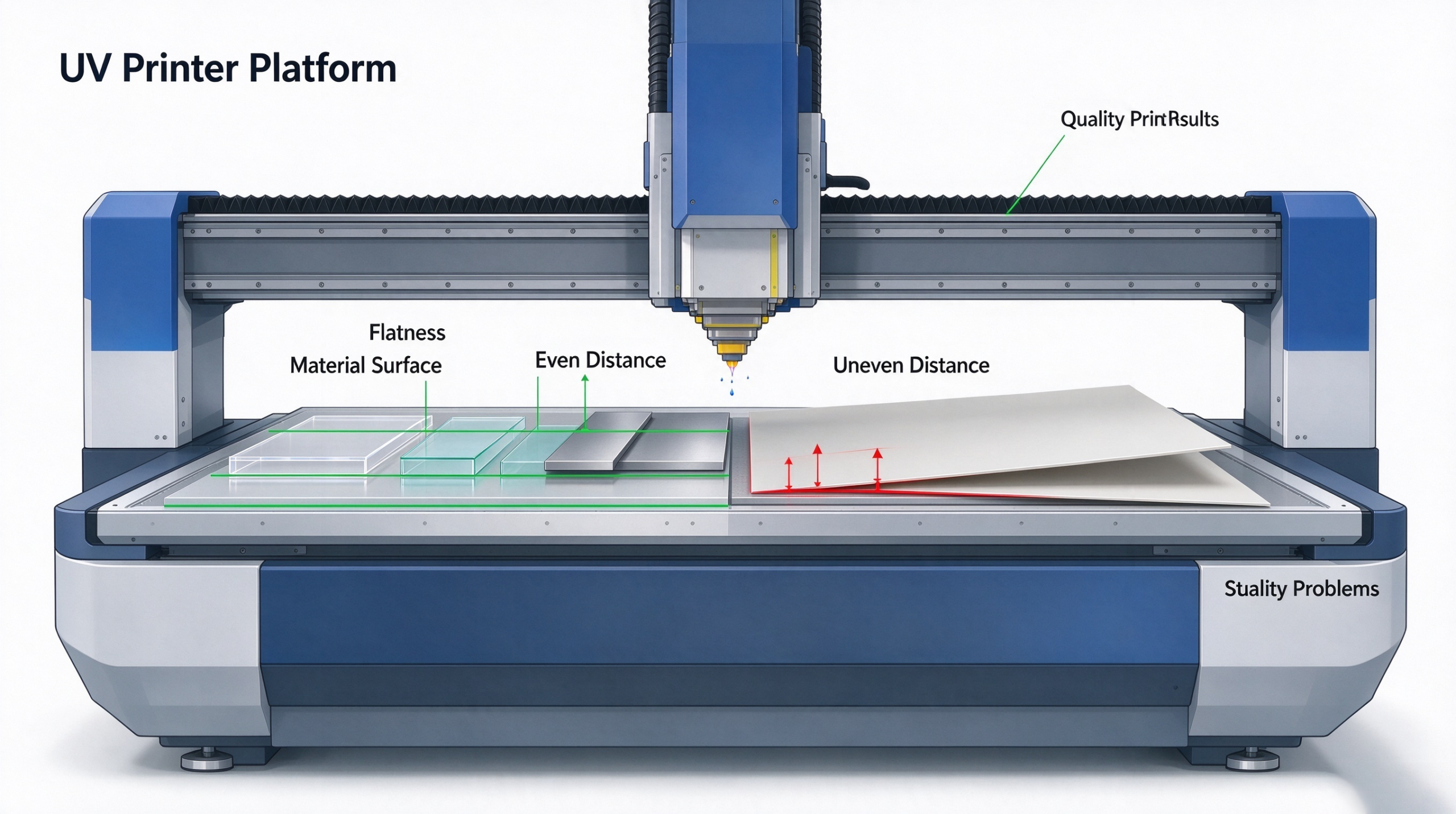
The most basic function of a UV printer platform is to support various printing substrates, including acrylic, glass, PVC sheets, metal plates, wood panels, and other flat materials. Unlike ordinary worktables, professional UV printing platforms adopt extremely high flatness standards.
If the platform is uneven with height deviations across the surface, the placed materials will also be unlevel. Even if the print head, ink supply system, and curing system work perfectly, the real-time nozzle-to-material distance will constantly change during printing. This causes inconsistent ink droplet placement, resulting in normal printing in some areas and defective output in others. Therefore, platform flatness is the primary prerequisite for high-precision UV printing.
2. Why the UV Nozzle Cannot Be Too Far From the Material
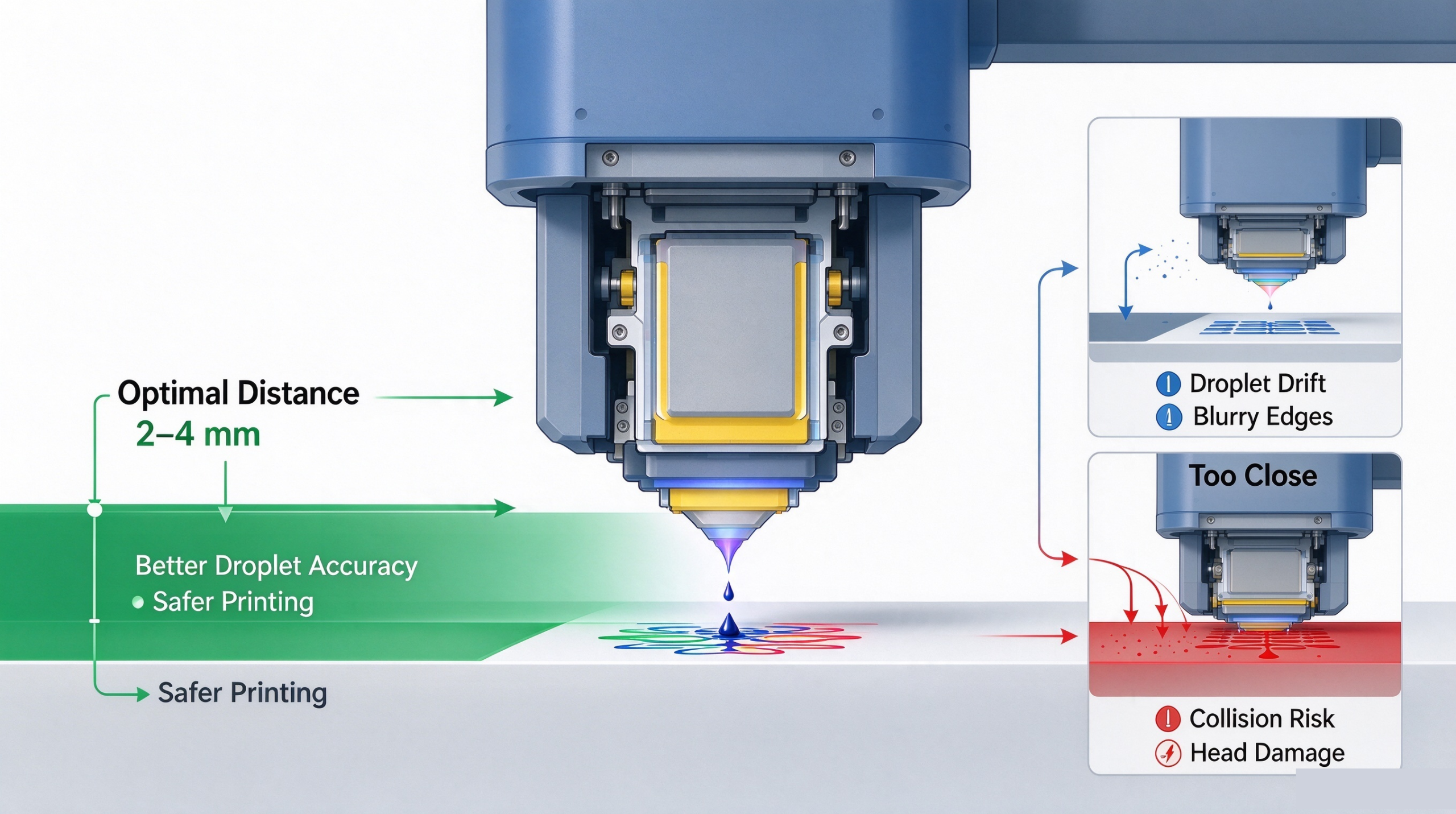
Unlike traditional inkjet printers that eject continuous ink lines, UV print heads spray countless tiny independent ink droplets. These micro droplets travel through the air and land on the material surface to form complete patterns.
Excessively large nozzle-to-material distance extends the flight path and duration of ink droplets. During flight, droplets are easily affected by air resistance, airflow disturbance, and initial jet velocity deviation. The prolonged flight distance causes tiny offsets in droplet landing positions, significantly reducing printing accuracy and leading to blurry pattern edges, faded colors, and inaccurate image alignment.
In short, excessive nozzle distance undermines ink droplet positioning accuracy, making it one of the leading causes of low-resolution and blurry UV printing results.
3. Why the UV Nozzle Cannot Be Too Close to the Material
Many users hold a misconception that the closer the nozzle is to the material, the higher the printing accuracy. In fact, an overly short nozzle distance brings significant equipment risks and printing problems.
In actual UV printing production, materials often have minor imperfections, such as slight warping, local protrusions, surface dust, and thickness errors. If the nozzle is too close to the material, the high-speed moving print head is highly likely to collide with the material surface.
UV print heads are high-precision core components with extremely high maintenance and replacement costs. Minor collisions can cause nozzle deformation and abnormal ink ejection, while severe collisions may permanently damage the print head. For this reason, nozzle height setting requires precise balance: ensure optimal ink jet accuracy while eliminating print head collision risks.
4. Why Height Adjustment Is Required for Materials of Different Thicknesses
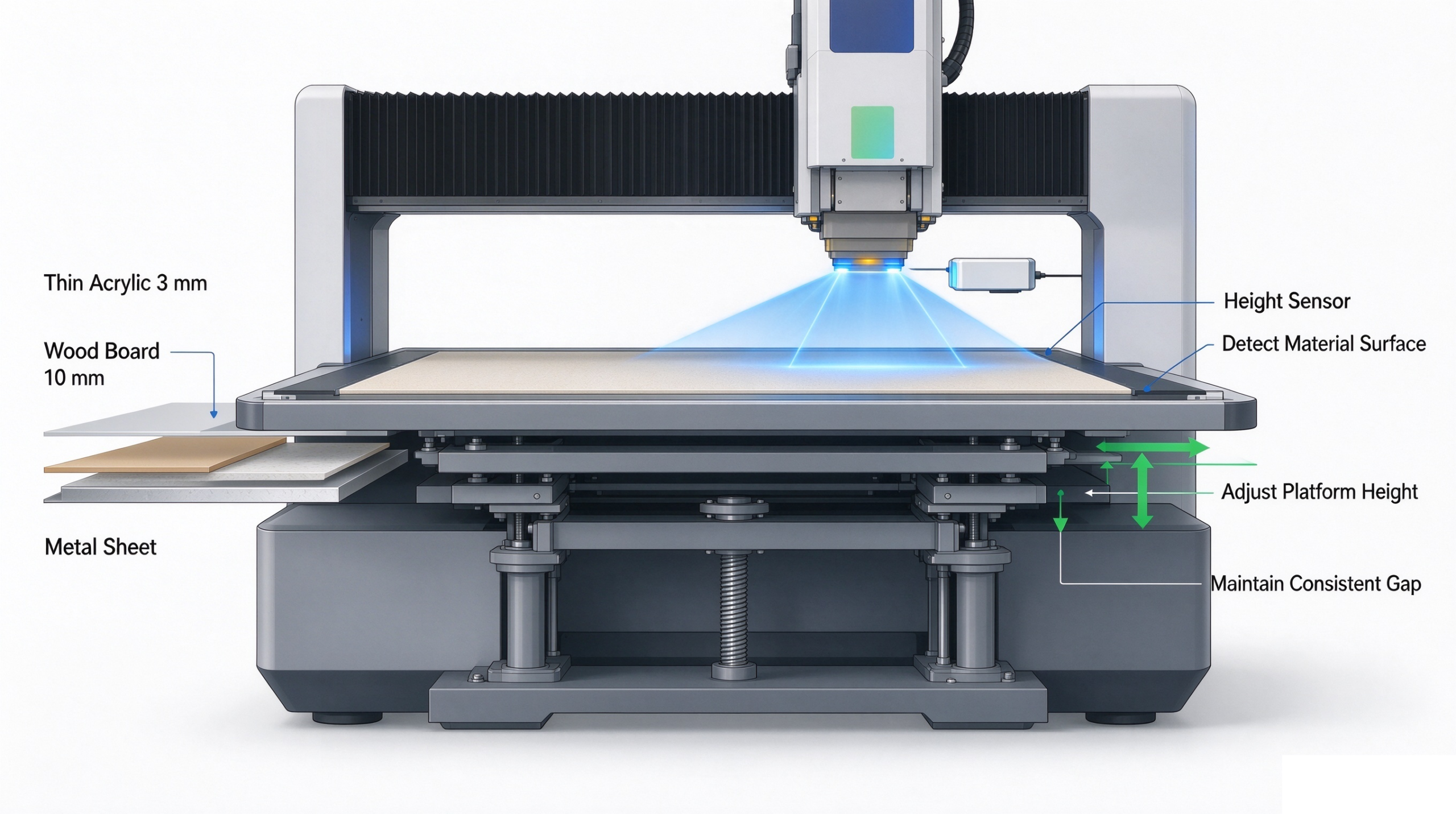
Custom UV printing frequently involves switching between materials of varying thicknesses, including 3mm thin acrylic sheets, 10mm thick wood panels, heavy metal plates, and ultra-thin PVC films.
A fixed platform height will directly alter the nozzle-to-material distance when switching materials. Overly thick materials create collision hazards, while overly thin materials result in excessive spacing and degraded print quality.
For this reason, all professional UV flatbed printers are equipped with a platform lifting system. The platform can be adjusted manually or automatically according to material thickness, maintaining the standard optimal nozzle spacing at all times and ensuring consistent, stable printing results for all substrates.
5. Working Principle of UV Printer Height Detection Systems
In batch printing and multi-specification material production, material thickness errors are unavoidable, and manual height adjustment is inefficient and imprecise. Thus, high-end automatic UV printers are equipped with high-precision height sensor systems.
The height detection system operates on a clear logic: before printing, sensors detect the real height of the material surface, automatically calculate deviations from the standard nozzle distance, and adjust the platform or print head height in real time. This intelligently eliminates printing defects caused by material thickness inconsistencies and greatly improves mass production yield rates.
6. Why Do UV Printer Platforms Need a Vacuum Suction Function?
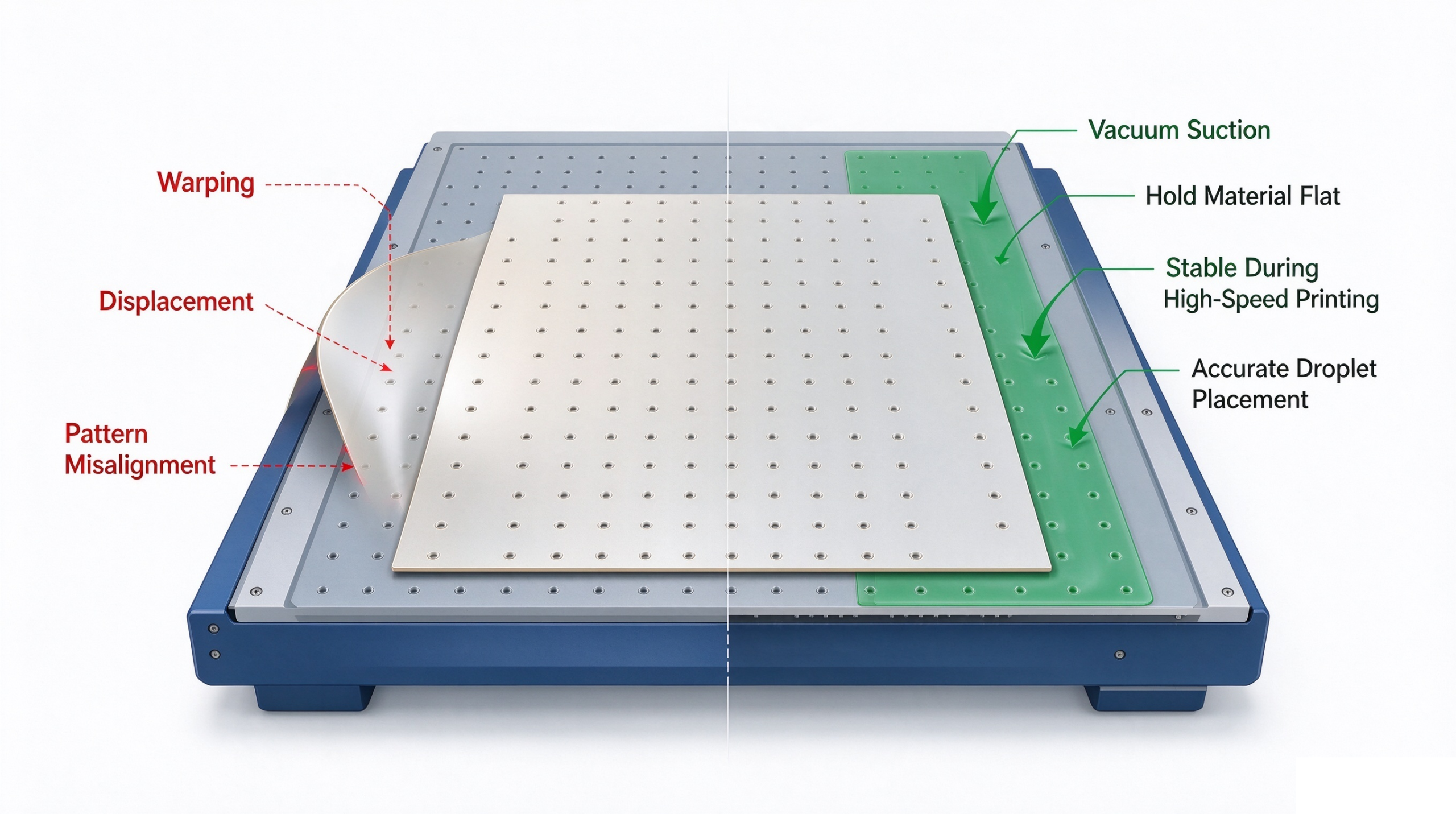
Formal industrial UV flatbed platforms feature dense suction holes paired with a vacuum suction system, an indispensable core configuration for high-quality printing.
During operation, the high-speed reciprocating movement of the print head generates subtle airflow and vibration. Thin plates, flexible materials, and large-size substrates are prone to slight warping, edge lifting, and minor displacement. Even the tiniest material movement can cause image misalignment, ghosting, and layer offset defects.
The vacuum suction system firmly adheres materials to the flat platform, completely eliminating warping, displacement, and vibration. It ensures materials remain completely static during high-speed printing, laying a solid foundation for precise pattern imaging and consistent color performance.
7. Common Printing Defects Caused by Uneven Platforms
Most users attribute poor print quality to clogged nozzles or inferior ink while ignoring platform-related issues. An uneven UV printer platform causes continuous fluctuations in nozzle-to-material distance across the printing area, triggering a range of common defects:
- Uneven Color Density: Partial over-dark or over-light patterns with inconsistent overall tone
- Reduced Printing Clarity: Offset ink droplets result in blurry edges and lost fine details
- Uneven UV Curing: Distance deviations alter ink layer thickness and UV light exposure, leading to incomplete curing and sticky surfaces
- Print Head Collision Damage: High spots on the uneven platform strike the moving print head, causing costly equipment failures
8. UV Printing as a High-Precision Integrated System
Premium UV printing results do not depend on a single component but on the coordinated operation of five core systems: mechanical structure, electronics, ink supply, optical curing, and control software.
The print head delivers accurate ink ejection; the motion system ensures stable and precise print head movement; the printing platform handles material fixation, flatness maintenance, and height adjustment; UV lamps achieve instant ink curing; and control software calibrates all operating parameters in real time.
Any precision error in the platform will break the overall system balance, which is why the mechanical accuracy of the UV printer platform is as critical as print head performance.
FAQ | Popular Questions About UV Printer Platforms and Nozzle Distance
Q1: What is the optimal nozzle-to-material distance for UV printers?
The industry-standard safe and precise spacing is 2 to 4 millimeters. This range balances ink jet accuracy and anti-collision safety, suitable for most flat materials such as acrylic, glass, and metal plates.
Q2: Can an uneven platform cause UV printing ghosting?
Yes. Poor platform flatness leads to irregular ink droplet placement and positional offset, resulting in overlapping images and ghosting, which is especially obvious in high-precision fine pattern printing.
Q3: Is vacuum suction mandatory for UV printing?
It is essential for thin and large-size materials. Thick, rigid plates with good flatness have lower requirements, but vacuum suction remains the best configuration for zero-displacement, high-precision printing.
Q4: Why adjust platform height for different printing materials?
Material thickness changes directly alter nozzle spacing. Height adjustment maintains the distance within the standard range, ensuring stable print quality and preventing costly print head collisions.
Conclusion
A UV printer platform is far more than a simple material placement board. Its core values include stable material support, superior flatness, precise height adjustment, and vacuum fixation. Cooperating with the print head, it builds a stable and accurate printing environment: the print head sprays ink precisely, while the platform provides a fixed, stable landing surface for all ink droplets.
When selecting and operating a UV printer, focus on four core platform indicators: flatness stability, vacuum suction power, lifting accuracy, and automatic height detection performance. Optimizing platform conditions is the most cost-effective way to improve UV print quality and reduce equipment failure rates.