
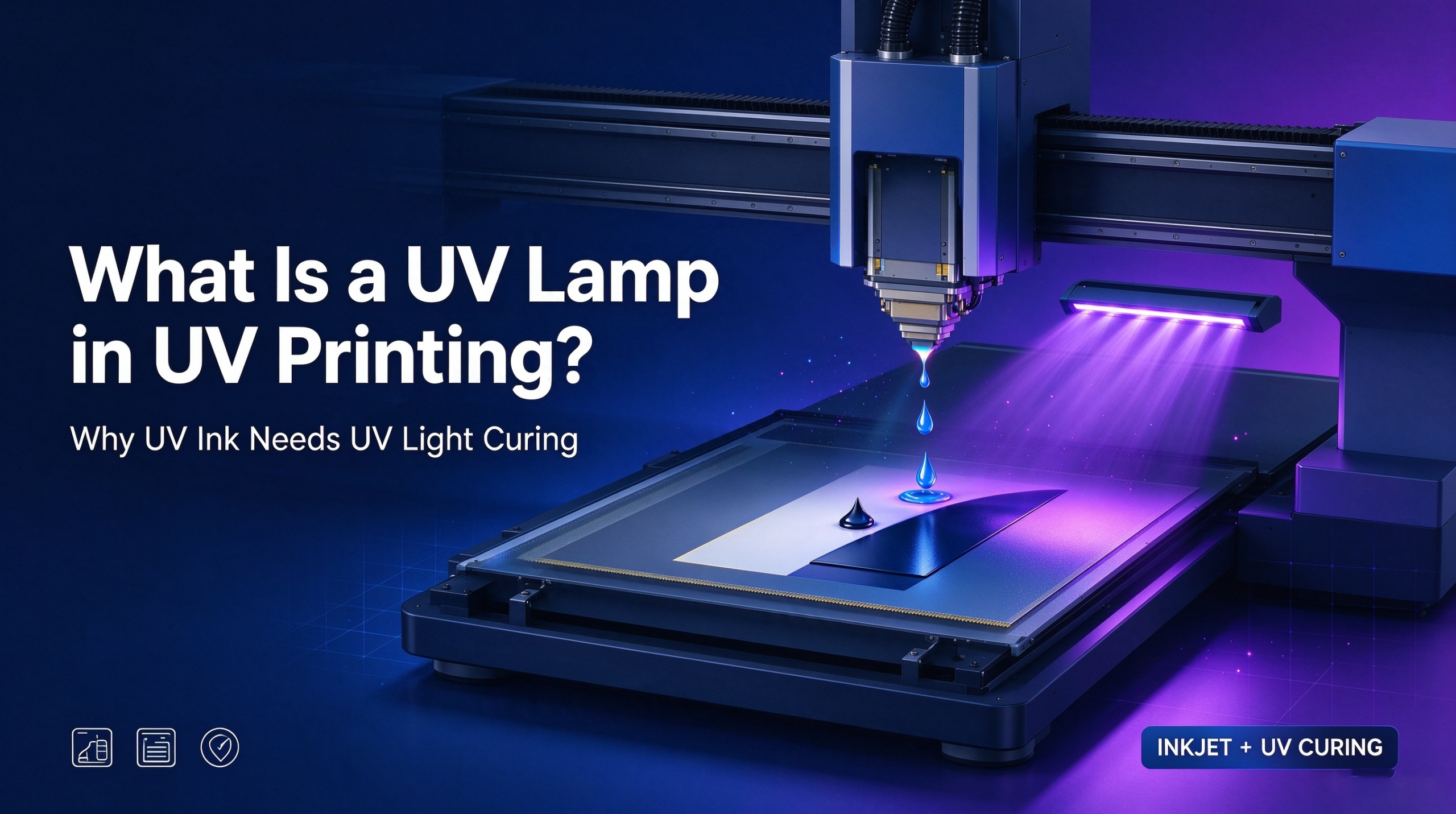
What is a UV lamp used for in UV printers? Why can UV ink only cure with UV light, while regular ink dries naturally? These are the most common questions for beginners in UV printing, custom printing businesses, and industrial printing production.
A complete UV printer works on two core principles:inkjet printing + UV light curing. The print head sprays liquid UV ink onto the material surface, and the UV lamp completes instant ink curing. Unlike traditional printing, UV printing does not rely on air drying, solvent evaporation, or material penetration.
In this in-depth SEO guide, we will explain how UV lamps work, why UV ink needs UV curing, common UV curing problems, and how to match UV lamps with ink for perfect printing results.
1. What Does a UV Lamp Do on a UV Printer? (Not Just Lighting)
Most people misunderstand that UV lamps are for illumination. In fact, the core function of a UV lamp is to trigger a photochemical curing reaction.
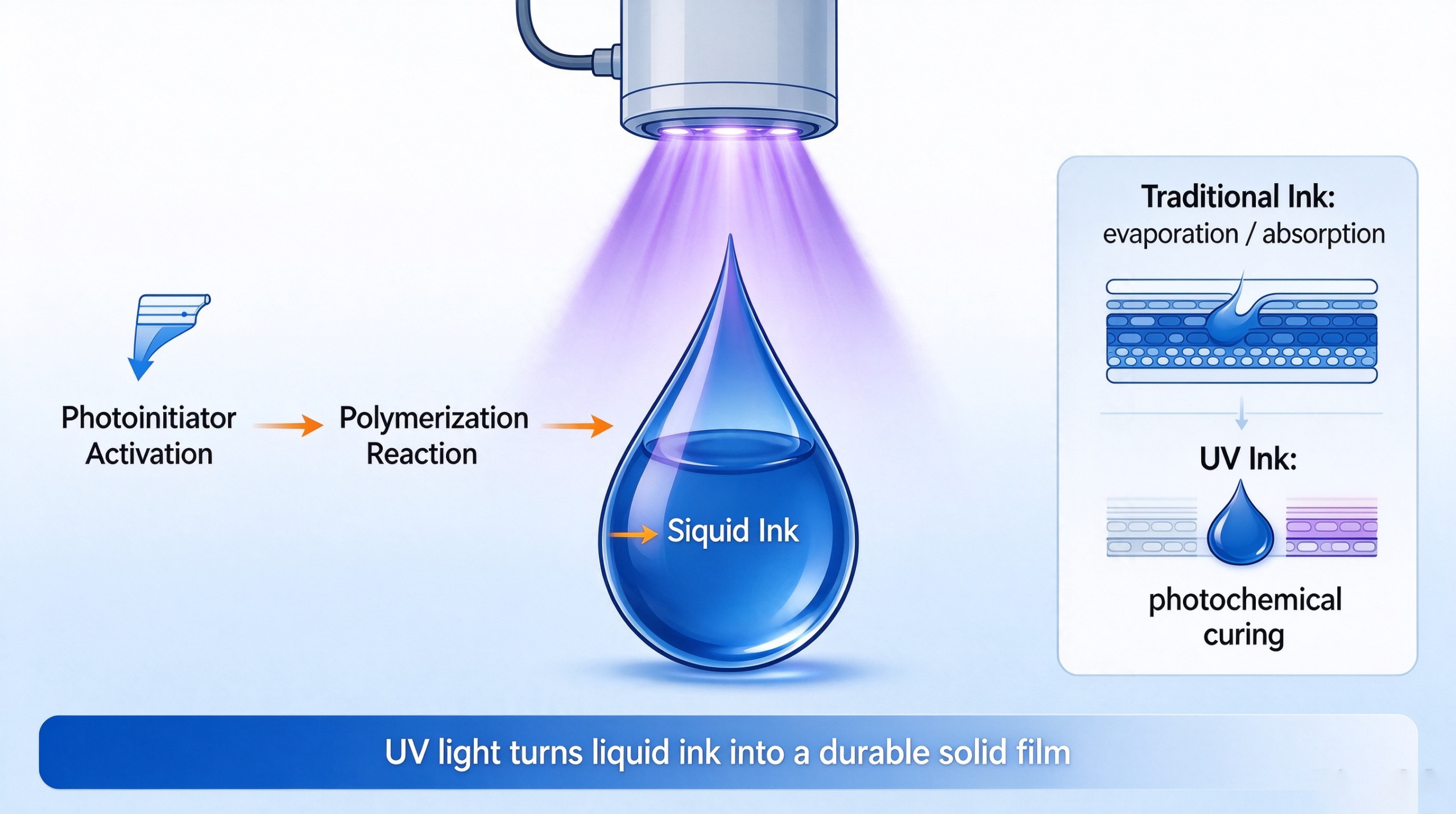
UV ink contains professionalphotoinitiators that remain inactive under normal light. When the UV lamp emits specific ultraviolet wavelengths, the photoinitiators in the ink are instantly activated, triggering a continuous polymerization reaction.
This chemical reaction turns liquid UV ink into a solid, durable ink film in milliseconds. This is the fundamental working principle of all UV printing technology.
2. Why Is UV Printing Dry-to-Touch Instantly? (Key Advantage Over Traditional Ink)
Traditional water-based or solvent-based ink relies on penetration, absorption, or solvent evaporation to dry and fix on materials. This method only works on porous materials like paper and fabric.
However, UV curing is a 100% photochemical reaction instead of natural drying. Right after the print head ejects ink, the adjacent UV lamp delivers precise UV irradiation to cure the ink immediately.
This is why UV printing supports instant dry, touchable, and scratch-resistant printing on non-porous materials, including:
- Glass
- Acrylic
- Metal
- PVC, plastic, and resin materials
- Ceramic, wood, and composite panels
No waiting time, no smudging, and no ink bleeding — this makes UV printing ideal for high-speed industrial production.
3. Is a Higher-Power UV Lamp Always Better?
A common misconception in the printing industry: the stronger the UV lamp power, the faster and better the curing effect. This is not true.
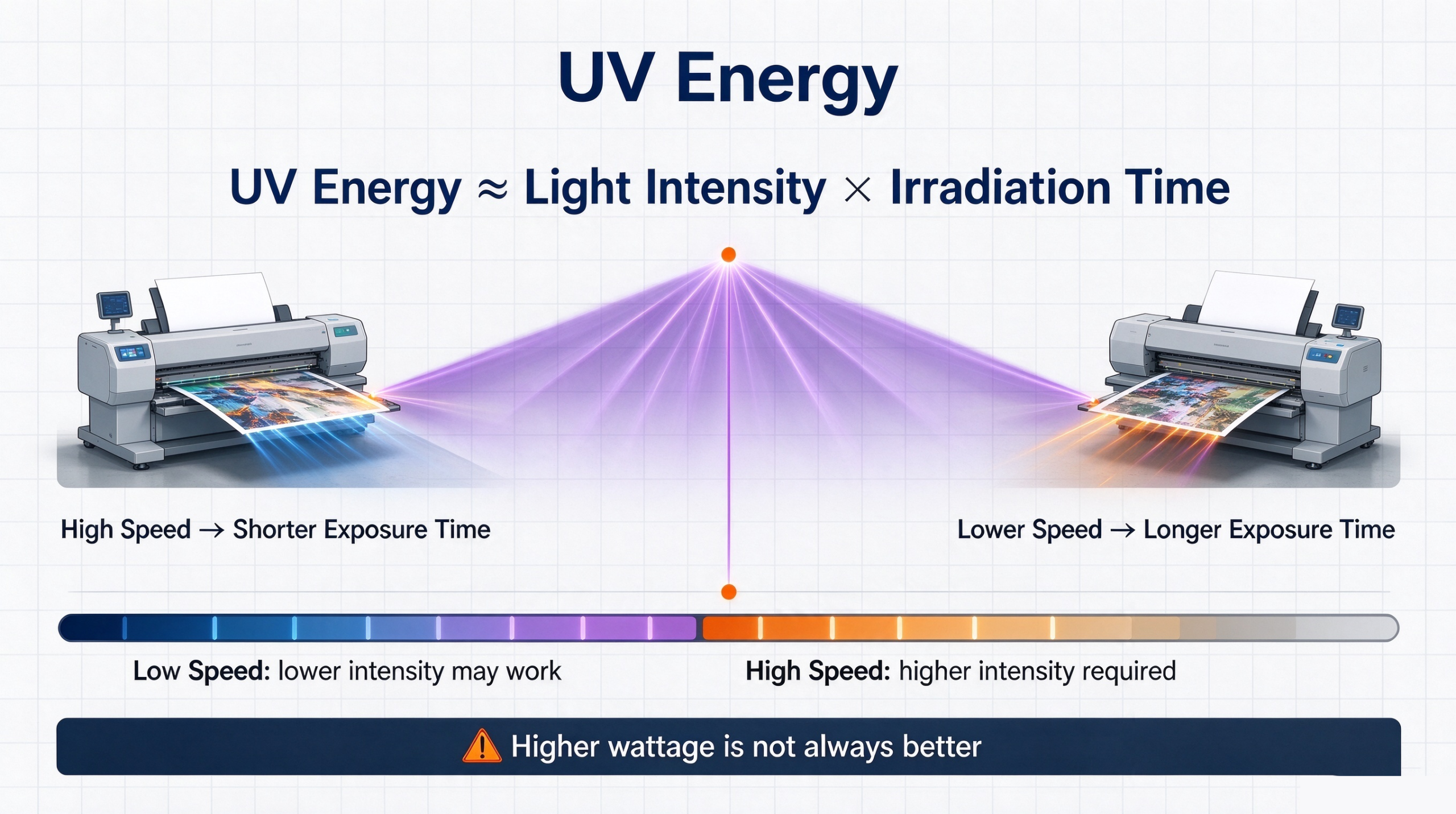
The actual curing effect depends on effective UV energy, following this core formula:
UV Energy ≈ Light Intensity × Irradiation Time
High-speed printing significantly shortens the UV irradiation time, which requires higher instant UV light intensity to ensure full curing. For low-speed printing, excessive lamp power will not improve quality and may even cause over-curing defects.
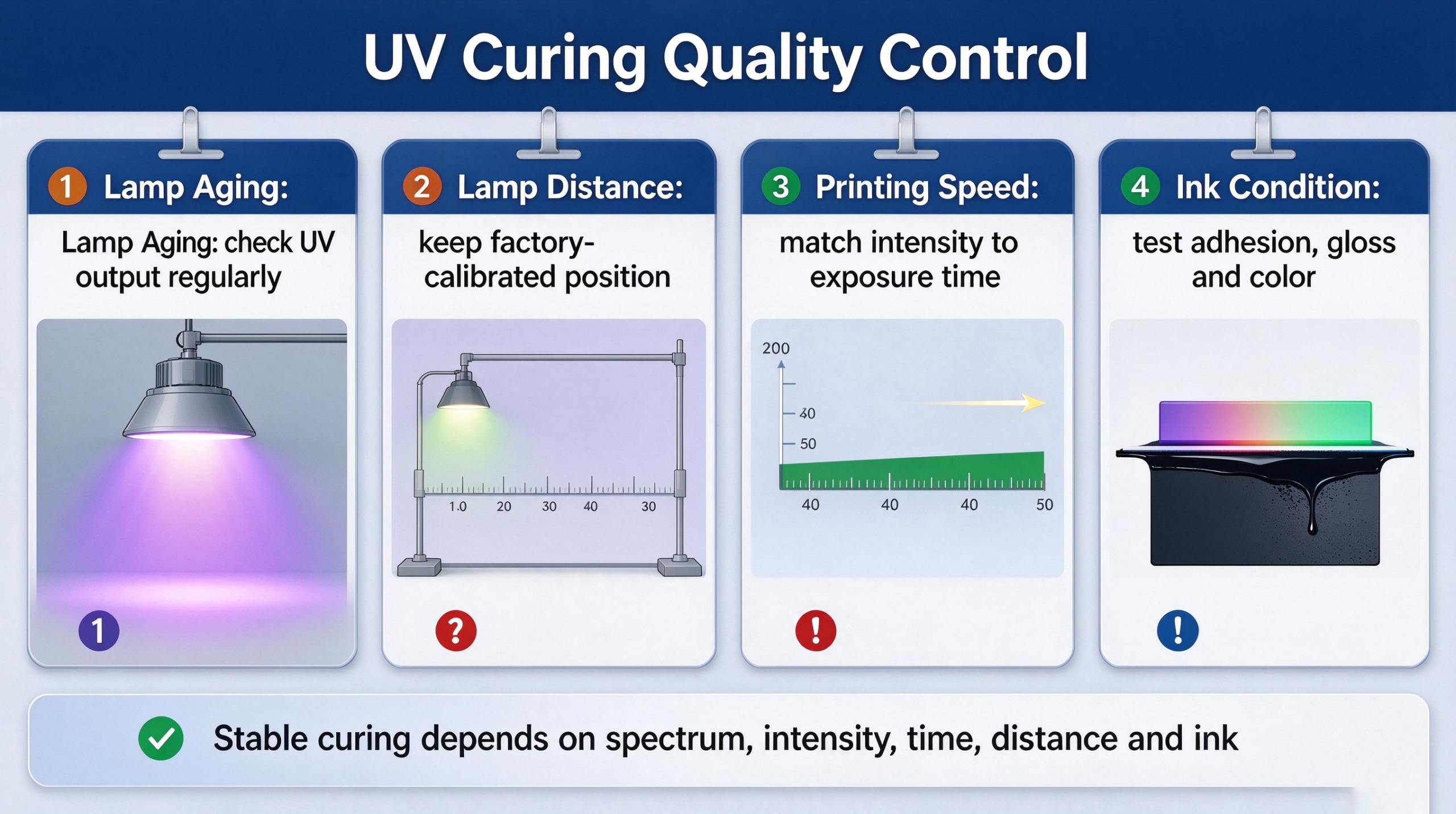
Perfect UV curing requires balanced matching of ink type, printing speed, UV spectrum, lamp distance, and irradiation area, not simply higher wattage.
4. Why Must UV Lamps and UV Ink Be Perfectly Matched?
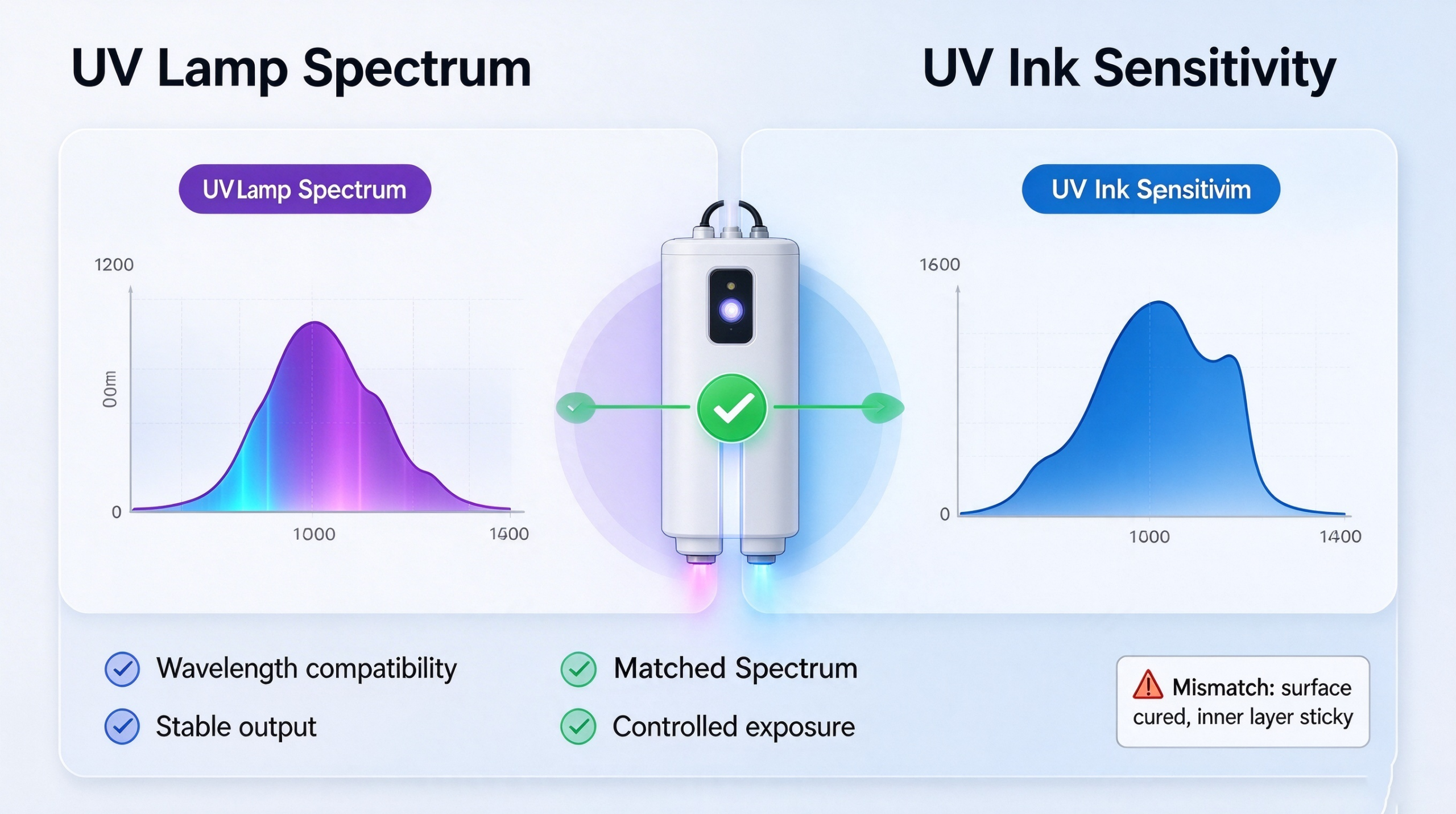
Different formulas of UV ink have different spectral sensitivity to ultraviolet light. No single UV lamp can adapt to all UV inks.
Mismatched UV lamps and ink will cause serious printing defects:
- Surface curing completed but inner ink layer remains uncured and sticky
- Over-curing leads to brittle ink film, reduced wear resistance, and poor adhesion
- Unstable surface gloss and inconsistent color performance
- Short-term ink peeling and fading in later use
For professional UV printing, UV ink and UV lamp system are an integrated solution, not separate replaceable parts.
5. How Does UV Lamp Aging Affect Printing Quality?
UV lamps have a fixed service life. With long-term operation, the effective UV output energy gradually decays, even if the lamp still lights up normally and your printer software parameters remain unchanged.
Aged UV lamps cause insufficient curing energy, leading to typical problems:
- Printed pattern surface sticky and not dry completely
- Ink layer easy to scratch off and poor adhesion
- Reduced wear resistance and weather resistance
- Color deviation and unstable printing effect
Therefore, daily UV printer maintenance includes not only print head cleaning but also regular UV lamp energy detection and replacement.
6. Why Cannot Modify UV Lamp Distance Randomly?
The distance, irradiation angle, and coverage range of the UV lamp directly determine the effective UV energy received by the ink layer.
A tiny change in lamp height or position will break the standardized curing environment, resulting in uneven curing, partial sticky ink, and inconsistent color brightness.
All formal UV printers are calibrated in factory for print head position, UV lamp height, irradiation angle, and light coverage to ensure stable and uniform curing in long-term mass production.
7. Common Defects Caused by Poor UV Curing
Improper UV curing (under-curing or over-curing) will trigger a series of printing failures:
- Ink surface sticky and difficult to dry
- Pattern peeling, scratching, and falling off
- Weak adhesion on hard materials
- Poor friction and scratch resistance
- Long-term performance degradation and color fading
Note: Ink peeling is not always a UV lamp problem. Material surface treatment, ink-material compatibility, printing parameters, and environmental factors also affect adhesion. Comprehensive troubleshooting is required.
8. How Does UV Curing Affect Printing Color Performance?
Most printers think color is only determined by ink. In fact, the final printing color is a combined result of ink formula + printing material + light environment + ink film surface state.
UV curing degree directly changes the thickness, compactness, gloss, and flatness of the ink film. Different curing states will produce completely different visual color effects, brightness, and saturation.
This is why UV curing system adjustment is a key part of UV color management — a lit UV lamp does not mean qualified curing.
Final Conclusion
The essential role of a UV lamp in UV printers is to emit specific ultraviolet light to activate UV ink photopolymerization and realize instant solidification.
High-quality and stable UV curing does not rely on ultra-high lamp power. It requires precise matching of UV spectrum, light intensity, irradiation time, printing speed, lamp distance, and ink characteristics.
Stable UV printing performance depends on the full coordination of the entire machine system: print head inkjet system, ink supply system, platform bearing, motion control, UV curing system, and RIP color processing system.
FAQs (Google Featured Snippet Optimized)
Q: Do you need a UV lamp for UV ink? A: Yes. UV ink contains no volatile solvent and can only be cured through UV photochemical reaction. It cannot dry or solidify naturally without UV lamp irradiation.
Q: What happens if UV lamp power is too high? A: Excessive UV energy causes over-curing, leading to brittle ink layers, reduced adhesion, surface cracks, and color distortion.
Q: Why do UV prints stay sticky after printing? A: Main causes include insufficient UV lamp energy, lamp aging, mismatched spectrum, fast printing speed, or incorrect lamp distance.